Most homeowners call me and say almost exactly the same thing: “I just want a ballpark. I know it’s going to be expensive, I just want an idea.” So here it is. A typical three-bedroom, two-bath ranch in Middle Georgia runs $15,000 to $20,000 for James Hardie fiber cement siding, primed and field-painted. Add soffit and fascia and you’re looking at $20,000 to $30,000 all in.
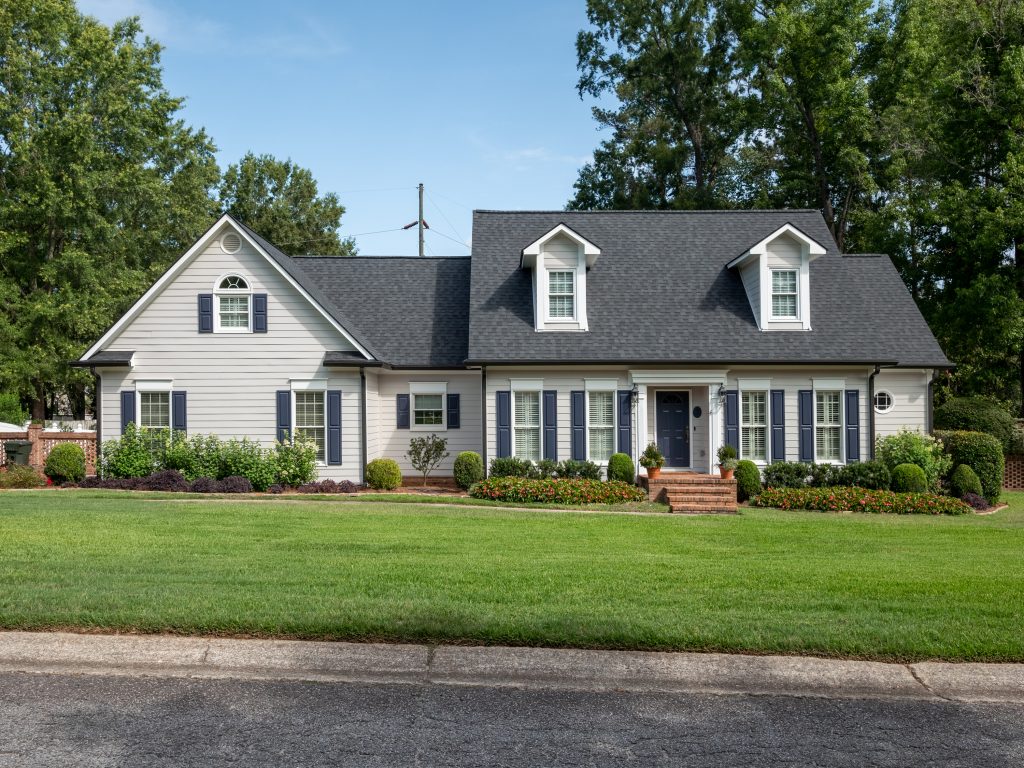
[PHOTO: After shot — completed Hardie install, wide, from the street]
Now let me show you where those numbers come from, and what makes them move.
What does a full siding replacement actually cost?
Here’s how it breaks down on a typical ranch, as of late 2026, in Metro Macon and Metro Atlanta.
| Scope | Range |
|---|---|
| Hardie lap siding, primed and field-painted | $15,000 – $20,000 |
| Soffit and fascia — repairs as needed on existing wood | ~$1,500 |
| Soffit and fascia — vinyl soffit, aluminum fascia | $3,000 – $5,000 |
| Soffit and fascia — James Hardie | $8,000 – $15,000 |
| Larger or two-story home with little brick or stone | $20,000 – $30,000 siding alone |
Profile changes the number too. Horizontal lap siding is your most cost-effective option. Board and batten — vertical panels with batten strips every 16 inches — is the next step up. Shake is the most expensive of the standard products. Get into Hardie’s Artisan and architectural lines and you’re in a different conversation entirely.
We don’t guess at any of this. We use HOVER to get exact measurements off your house and build a 3D model, so we can show you what your home looks like in different colors and different profiles before you commit to anything. That measurement gives us square footage with waste, without waste, and with openings. We average it and come up with a board count.
On the job sitting on my desk right now: 2,200 square feet of siding, 332 boards of horizontal lap. Our estimate prices it down to the board — the nails, the staples, the house wrap, the seam tape, the siding, the trim. You can see exactly what you’re getting and exactly what you’re not.
Why can’t you just repair the siding I have?
A lot of people call asking for a repair. I wish that answer was simpler.
Most of the homes we re-side have either vinyl, or old LP or Georgia Pacific siding that has basically crumbled. It’s cardboard with a texture on it, and at this point the paint is about the only thing holding it together.
Here’s what happens when we try to repair it. You pull one board at the bottom. The next board falls apart. Then the next one. Then the one above that. You end up replacing the whole section anyway. And if you’ve got a problem in one area of the house, you almost always have a problem in two or three more.
So the honest answer is that on this siding, a repair usually isn’t a repair. It’s a section. And a section usually turns into the house.
What’s behind your siding, and what happens if nobody checks?
This is the part almost nobody bids for, and it’s the reason two estimates can be thousands apart.
Somewhere between 80 and 90 percent of the homes we re-side around Metro Atlanta and Metro Macon — the ones built from the late 1980s into the early 2000s — don’t have OSB sheathing behind the siding. They have black insulated foam board, Celotex or something like it.
Hardie doesn’t require OSB. I still recommend it, and here’s why. You’re nailing into the studs either way, but with foam board the siding grabs and sinks into the wall as that foam squeezes. You end up looking at wavy siding. It’s not a warranty problem. It’s a “you paid $20,000 and it doesn’t look right” problem.
So we price it up front as an option you can check or uncheck. On that 332-board job, replacing all 69 sheets of OSB is $1,265.66 in material and $1,971.43 in labor — about $3,237 worst case. You see that number before we ever start.
Then we tear the siding off and find out what’s actually there. If only 15 sheets need replacing, you get charged for 15 at the board rate. Not 69. We back the rest out. You know your worst case going in, and you pay for what we actually did.
What I can’t price up front is what’s behind the sheathing. Rotted studs, rotted framing — that’s a genuine unforeseen condition, and anybody who tells you otherwise is guessing.
A few other things move the number that homeowners never see coming. Access is the big one. As long as we can get pump jacks and ladders within about five feet of the house, you’re fine — a normal two-story on a basement is no problem. Where it gets expensive is a two-story on a basement sitting on an elevated foundation eight or ten feet off the ground. I’ve worked houses that were effectively four stories up, fifty feet in the air, needing lifts and extra pump jacks and safety equipment. That changes the price significantly. Same with a driveway too steep to deliver material up — if we’re parking at the road and carrying it, that’s real labor.
ColorPlus or paint it later — which one is right for you?
Every number above is primed and field-painted after install. Hardie’s ColorPlus is the prefinished product, and it costs meaningfully more up front.
I had a customer at the beginning of 2025 with a three-bed, two-bath ranch. Siding, soffit, fascia and gutters, primed and painted, was $25,000 to $30,000. That same house in ColorPlus was right around $50,000. Today, almost the end of 2026, that same job is closer to $55,000 to $60,000. So yes — ColorPlus adds $20,000 to $30,000 on a full siding, soffit and fascia replacement.
Here’s the tradeoff. With primed and painted, you’re looking at roughly a five to seven year paint cycle. Some customers get ten. It depends on UV exposure, wind, sun, which direction the wall faces. ColorPlus carries a fifteen-year finish warranty.
You’re either paying for it now, or you’re paying for it later.
Run the math. Say painting costs you $10,000 today. Five to seven years out, with inflation and labor, call it $12,000 to $15,000. Five to seven years after that, $14,000 to $17,000. And that’s before you factor in picking colors again, and vetting another contractor again, and wondering again whether they’re going to do what they said. By the time you’ve been through all of that, you’ve often spent more than the upfront difference.
But it isn’t automatic. What I actually ask people is: how long are you going to be in this house?
- Flipping in a year or two? ColorPlus usually isn’t worth it. You want a good installation so an inspector or appraiser doesn’t ding you for failing LP siding or a bad Hardie install — and that’s it.
- Five to ten years? That’s the iffy zone. At five years you probably don’t recoup it on paint savings alone. What you do get is a selling point: this went on five years ago and the finish is warrantied another ten.
- Staying put? That’s when ColorPlus earns its money.
I’ve got houses we sided in 2008, 2012, 2013 and 2015. You can drive by them today. They still look brand new — just as colonial red as the day we installed them.
Why is one bid $10,000 cheaper than everybody else’s?
This one comes up constantly. A customer tells me they’ve got a contractor who’ll do it for ten thousand less. I ask to see the estimate. It’s one page: Replace siding — $15,000. Name, address, phone number, maybe some legal language at the bottom.
Mine is four pages, line by line. Siding, removal, labor, house wrap and which house wrap, soffit and fascia, paint, gutters. So the real question isn’t which number is lower. It’s what’s actually inside that one page. Does $15,000 include paint? Soffit and fascia? Is it Hardie best practice, or just fast?
Let me answer the thing you’re actually wondering. Can you get siding done for ten or fifteen thousand less than All American Renovations? Absolutely you can. I’m not going to pretend otherwise.
Will it be installed to the standard that keeps your 30-year non-prorated Hardie warranty fully intact? Probably not.
Here’s a test you can run yourself, and I don’t know another contractor who’ll tell you this. Get four bids from James Hardie Alliance contractors and one from somebody who isn’t. Ninety-nine times out of a hundred, three or four of those Alliance bids will land within three to five thousand dollars of each other, because we’re all following the same install manual. You might get one that’s ten or fifteen thousand higher. And the non-Alliance bid will be the outlier at the bottom.
That clustering is the signal. When four independent contractors following the same standard land in the same range, that range is what the work costs.
And it cuts the other way too. If somebody comes in twenty thousand above everyone else promising to handle all repairs no matter what they find, that’s a swing in the wrong direction. That’s padding, not thoroughness.
When you’re comparing, ask each one: Are you addressing the sheathing behind the siding? Is trim around windows and doors included? Generic house wrap, or HardieWrap? A cheap bid is going to look like a cheap bid once you know what to look for.
What actually fails when Hardie gets installed wrong?
This is the part you can’t see on the day you sign, and it’s why the cheap bid costs you more.
The Hardie install manual is a quarter to a half inch thick. It covers just about anything you can think of. We give our installers quick reference guides and run checklists to keep them in line with it. A few of the things that manual is adamant about:
- Nailing into studs. Joints in particular have to hit studs. This is the big one.
- Clearances. Between roof decking and siding, and between siding and concrete or grade, so water isn’t wicking up into the bottom of the board.
- Flashing behind joints instead of caulking them.
- Kick-out flashing where fascia meets siding, so water gets kicked into the gutter instead of running down the wall and delaminating the board.
Now here’s how it fails. The installer misses studs. To make it look tight, he pins every board back against the wall. Then the painter comes in and putties and caulks over it, and honestly? It looks great. The untrained naked eye is not going to catch any of it, because paint covers most of those mistakes.
Then the seasons change. That board expands and contracts, like it’s designed to. Those nails that never hit a stud start to loosen and pull. The board starts slipping. It starts bowing out. And one windy evening you start hearing the siding flapping against the wall.
You’re six or twelve months in. Your contractor gave you a one-year warranty. It’s up, or about to be, and now you don’t know what to do.
That’s why we warranty our installation labor for thirty years — matching Hardie’s 30-year non-prorated warranty on the board itself. [NEED FROM THOMAS: confirm exact workmanship warranty wording matches your contract before this publishes]
What I’d tell you if you called me
- Budget $20,000 to $30,000 for a typical ranch with siding, soffit and fascia. Under $15,000 for a whole house, something is missing from that bid.
- Ask every bidder what happens if there’s foam board behind your siding. If they don’t have an answer, they haven’t looked.
- Get a line-item estimate. Not a one-page number. If a contractor won’t break it down, you have no way to compare.
- Decide on ColorPlus by how long you’re staying, not by the sticker. Two years, skip it. Long haul, it’s usually the better buy.
- Don’t take the low bid without knowing why it’s low. It’s not always wrong. But you should know what you’re trading.
Thinking about siding?
If you’re anywhere in Middle Georgia or Metro Atlanta and you want a real number instead of a ballpark, I’ll come walk your house. We’ll pull HOVER measurements, show you what your home looks like in a few different colors and profiles, and give you a line-item estimate you can actually compare against anybody else’s.
No pressure, and no obligation to use us. If you just want to understand what you’re looking at before you talk to anybody, that’s a fine reason to call.

Thomas Williams is part of the team behind All American Renovations, helping homeowners throughout Middle Georgia and Metro Atlanta make informed decisions about exterior renovations. With hands-on experience in siding, roofing, and home improvement projects, Thomas focuses on helping homeowners understand their options, compare materials, and know what to expect before starting a renovation.