A whole-home exterior renovation runs between $55,000 and $125,000.
That’s roof, soffit and fascia, gutters, siding, windows, and either paint or ColorPlus. Everything on the outside of the house, done at once.
That’s a wide range, so the rest of this post is about where inside it your house lands and why. I’m going to give you both ends itemized, tell you how long it takes, tell you what isn’t in the number, and then tell you how to do it in stages without me if that’s the right call for you.
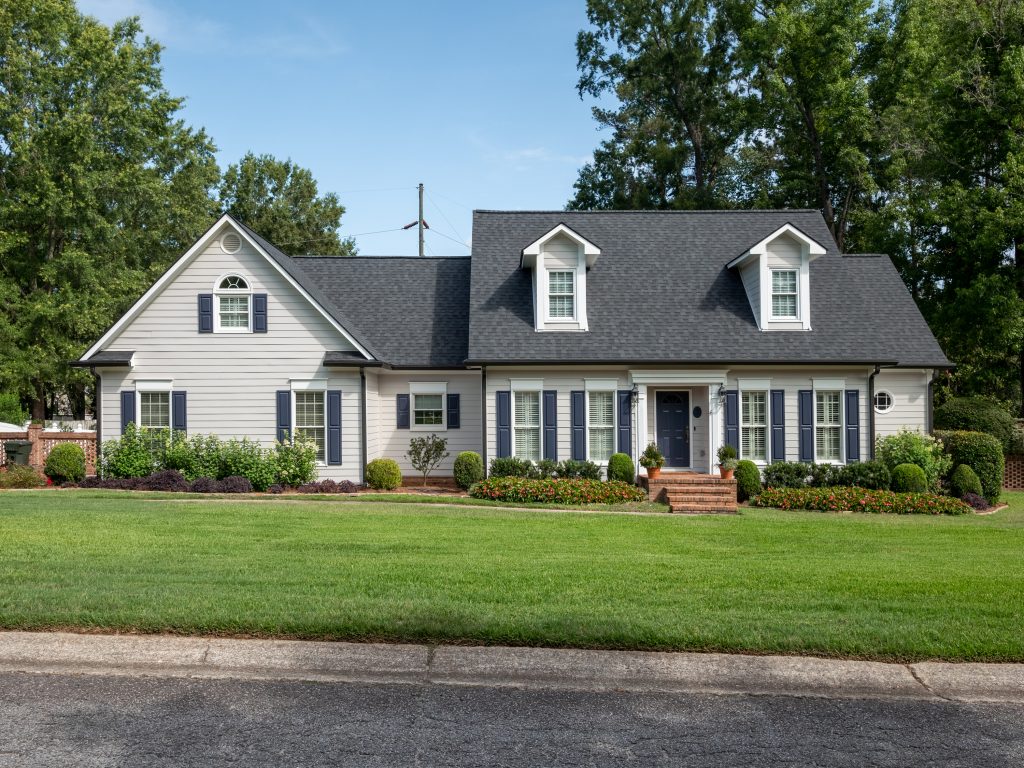
[PHOTO: a completed full exterior renovation, before and after, same camera position]
THE $55,000 VERSION, ITEMIZED
Here’s a real, common project. A 2,000 square foot, three bedroom, two bath ranch.
– James Hardie siding, primed, plus soffit and fascia
– Painted after installation
– Seven to ten new windows
– A roof — about 2,500 square feet, which is 25 squares, in CertainTeed Landmark architectural shingles
– New seamless gutters and downspouts, no leaf protection
That house, that scope, lands around $55,000.
THE $125,000 VERSION
Same size house. Here’s what changes.
Siding, soffit and fascia in ColorPlus instead of primed and painted, with minimal design elements: $55,000 to $65,000 on its own.
Then windows go on top. White-on-white vinyl adds $10,000 to $15,000. Designer-style windows — different colors, different grids, different glass — run $17,000 to $30,000.
Then the roof. On a house this size, about 25 squares, a CertainTeed Landmark or Landmark Pro roof runs $14,000 to $23,000. Pitch, height, how many layers are already up there and whether the decking is sound are what move it inside that range, and the roofing post breaks all of it down.
And gutters. A full-house gutter job runs $2,500 to $4,500, and past $6,000 on a house with a lot of roofline. Worth knowing that a ranch has more roofline than a two-story of the same square footage, because it’s spread out instead of stacked — so a house like this one sits nearer the top of that range than the bottom.
Stack the top of each and you’re at roughly $125,000. That’s the ceiling on a house this size, and I’d rather print it than have you find it.
So what actually moved you from one end to the other?
Three things, in order of how much they matter.
1. ColorPlus or primed and painted. This is the biggest single lever on the whole number, and it’s a whole post on its own. Short version: ColorPlus is factory-applied finish, primed is painted on site after installation. They cost different amounts, they last different amounts of time, and which one is right depends heavily on how long you plan to be in the house.
2. Windows. The gap between plain white vinyl and designer-style windows on the same house is $10,000 to $15,000 versus $17,000 to $30,000. That’s the second-biggest swing in this entire project, and it’s almost entirely a looks decision. Not a wrong one — just know that’s what you’re deciding.
3. Shingle tier. Smaller than the other two. Our roofing cost post breaks the tiers down properly.
And design elements. Shake in the gables, board and batten sections, a different profile on the front elevation. Every one of them is real money and every one of them is optional. On our proposals they’re tick boxes — you check them on and off and watch the price move — so you can build the house you actually want instead of me guessing at it.
[PHOTO: the JobTread proposal screen with options toggling and the price changing]
How long does it take?
I get this question on nearly every call. Here’s how I answer it — I break it down by trade, because “about a month” doesn’t help anybody plan, and because a whole exterior isn’t one job. It’s five or six of them in sequence.
Siding: one to three working weeks. Two weeks for siding alone. Three weeks for siding plus soffit and fascia. Size and complexity move it.
ColorPlus: two to three weeks, just about every time, assuming we don’t find rot.
Paint: three to five working days. Weather depending, and in Georgia that’s a real caveat.
Windows, installed alongside the siding: one to two days. Doing them during the siding phase is why that number is so small.
Roof: one to three business days.
Gutters: one day.
Rot: two to three days if it’s minor. One to two weeks if it’s bad. That’s the variable nobody can quote you up front, and I’ll come back to it.
Add those up on that ranch and a full exterior in primed-and-painted is four to five working weeks of actual work. In ColorPlus, closer to three and a half to four.
But that’s working time, not calendar time, and I’m not going to blur the two.
The reason I break it down by trade instead of handing you one number is that there is sometimes downtime between trades. The siding is finished and the painter is backed up and can’t start for a week. That week isn’t in any of the figures above, and it’s real.
So the honest version is: that’s what the work takes, and the calendar can run longer. What you should expect from us is that you know about a gap before it happens rather than wondering why nobody’s at your house on a Tuesday.
And here’s something worth sitting with. ColorPlus costs more and finishes sooner — because there’s no three-to-five-day paint phase at the end, and no waiting on a painter’s schedule either. If your timeline matters as much as your budget, that’s a real consideration and I’ve never heard anybody in this trade mention it.
When can you actually start?
It depends on when you sign, and nothing else.
We schedule in the order contracts are signed. Not by job size, not by who’s most persistent. First signed, first scheduled.
Our schedule typically runs four to six weeks out. Slower months it comes down to two to four. Busier times of the year it stretches to six to eight.
So if you want to be sided in April, the conversation happens in February.
What’s not in the number?
This is the part most cost pages skip, so let me be specific.
What’s behind your siding. We don’t know until we take the old siding off. Nobody does.
Here’s how we handle it rather than surprising you: sheathing is priced on the page before we start, at worst case, so you can see the number. If we don’t use all of it, you aren’t charged for all of it. You pay for what actually goes on your house.
When we do find something, the numbers look like this. Truly unforeseen conditions — the kind that catch everybody off guard — typically run $2,500 to $5,000. The significant ones run $8,000 to $15,000.
And I’ll tell you honestly: there are indicators that let us expect the bad ones in advance. On houses showing those signs, we say so before you sign, and some customers adjust what they take on. One customer this year wanted soffit, fascia and gutters as well, and after we walked through what we expected to find behind the stucco, they deferred that work rather than blow the budget. That was the right call and it came from talking about it up front.
Permits. They show as a line on our proposal at $0.00 with a note, because the municipality sets the cost and we bill what it actually is. An unpermitted job that catches a stop-work order gets fined at twice the permit cost, so this isn’t a corner worth cutting.
What if I want a deck too?
Customers ask this constantly, and the answer is yes — decks get added to whole-home projects all the time.
A small TimberTech deck — call it twelve by twelve — starts around $15,000 and goes up from there. What moves it:
– Whether it has railings
– Which TimberTech line you choose
– Demo of the old deck
– New framing
– Footings
– Stairs
– How high off the ground it sits
A deck has too many variables to price properly in a paragraph, and it deserves its own breakdown rather than a number I’d have to hedge. It’s also worth saying plainly: plenty of houses don’t have a deck at all, which is exactly why it isn’t inside the $55,000.
Why do it all at once?
Here’s where I could sell you hard and I’m not going to, because the honest answer is smaller than you’d expect.
The money you save by bundling is modest. Let me actually account for it:
– Windows cost more in labor as a standalone project than they do installed alongside siding.
– Every separate project is another dumpster. One’s already sitting in your driveway for the siding.
– A roof costs essentially the same whether it’s done with everything else or on its own. Another dumpster, and that’s about it.
That’s the whole financial case. It’s real, but it isn’t tens of thousands of dollars and I’m not going to pretend it is.
The actual argument is somewhere else entirely, and it’s this:
The coordination of proper flashing between the siding and the roof is the biggest thing to look at.
That’s where houses leak. Not in the middle of a wall and not in the middle of a roof — at the transition between them. Kick-out flashing where a roof meets a wall. Flashing above horizontal trim. Flashing where masonry meets siding.
When one company does the siding and a different company does the roof, that transition belongs to nobody. And when water shows up two years later, you get two contractors pointing at each other while you stand in your kitchen with a bucket.
That’s the reason to do it at once. Not the dumpster. One company owns the seams, and there’s nobody to blame but us.
And if your’e going to do it in stages anyway – Here’s the order
Plenty of people can’t or won’t do it all at once, and that’s a legitimate choice. So here’s how to sequence it so you don’t pay for the same work twice.
1. Windows first. Do windows before siding and your window trim gets installed once. Do siding first and you’ll replace that trim when the windows go in.
2. Siding, soffit and fascia next. Do these before the roof and the roof’s drip edge doesn’t have to come off and go back on.
3. Shingles last.
Gutters go after soffit and fascia — before or after the roof, either works.
Follow that order and the piecemeal approach costs you very little extra. Go out of order and you’ll pay twice for trim, or twice for drip edge, or both.
That’s advice you can use whether you hire us or not, which is the point of writing it down.
What I’d tell you if you called me
– Decide on ColorPlus versus primed and painted first. It’s the biggest lever on your number and it changes your timeline too.
– Ask what the windows are adding, separately from everything else. It’s the second-biggest swing and it’s mostly a looks decision.
– Ask how sheathing is handled — priced up front at worst case, or discovered later at a number you’ve never seen?
– Ask what happens if they find rot, and get the answer before you sign.
– Ask how the schedule is set. If it isn’t “the order contracts are signed,” ask what it is.
– Ask what happens between trades. A whole exterior is five or six jobs in a row, and the gaps between them are where a schedule quietly slips. Ask how you’ll be told about one.
– If you’re staging it, do windows, then siding, then roof. In that order, whoever you hire.
– Ask who owns the flashing between the roof and the walls. If two companies are doing the work, the honest answer is nobody.
Thinking About the Whole Outside of Your House?
If you’re in Middle Georgia or Metro Atlanta, the first step is a phone call — not a salesman in your living room. It runs thirty to forty-five minutes, we’ll ask you more questions than you ask us, and you’ll get a real price range before anybody drives anywhere.
And if a full exterior isn’t the right move for you right now, we’ll tell you that on the call rather than three weeks in.

Thomas Williams is part of the team behind All American Renovations, helping homeowners throughout Middle Georgia and Metro Atlanta make informed decisions about exterior renovations. With hands-on experience in siding, roofing, and home improvement projects, Thomas focuses on helping homeowners understand their options, compare materials, and know what to expect before starting a renovation.