By Thomas Williams, All American Renovations
Every exterior quote starts with one number: how much house there is. Square footage of siding, squares of roof, linear feet of trim and gutter.
And the way most contractors get that number is by estimating it from the street.
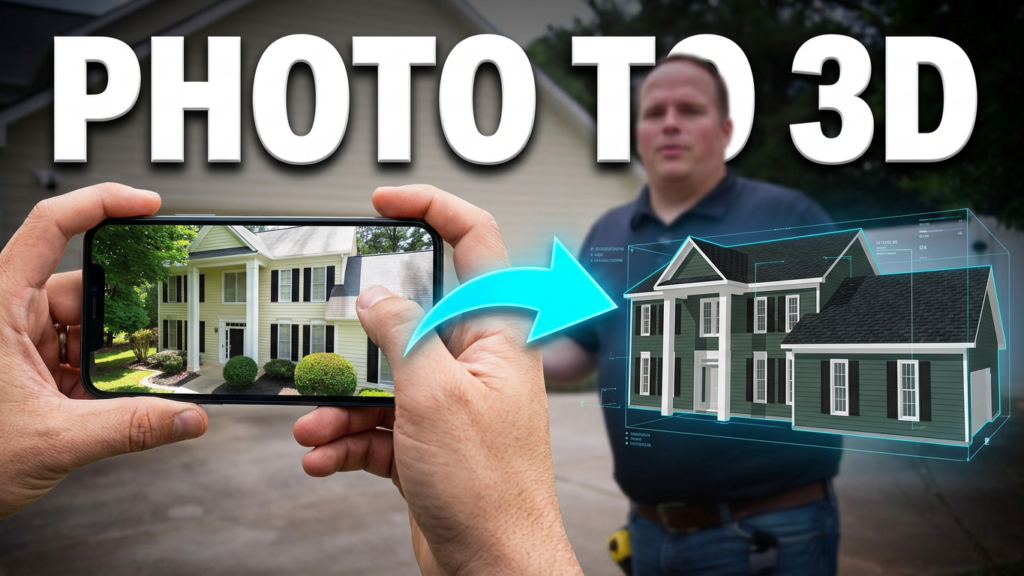
Here’s ours, and the part that surprises people: most of the time, our customers take the photographs themselves. From their own yard. On their own phone. Before we ever come out.
Watch it happen first
I recorded myself doing it, start to finish — taking the photos and showing the 3D model that comes out the other end.
It’s the fastest way to understand what follows, and it’s the same process whether we’re doing your siding, your roof, your windows or all of it.
What HOVER actually is
HOVER builds a three-dimensional model of your house out of ordinary photographs.
You walk around the outside, take a set of pictures, and it returns a model with real measurements in it — every wall, every roof plane, every opening, every slope.
We’ve been using it since 2017. We measure siding with it and we measure roofs with it, and the model is where the first line of your quote comes from. [Siding square footage: why every contractor’s is different — post 70] and [Roof squares: why every contractor’s number is different — post 76] explain what we do with those figures once we have them.
Why we’d rather you took the photos
Three reasons, and the first one is the honest one.
- It’s faster for you. You don’t wait on a visit to find out roughly what you’re dealing with. Photos one evening, model the next day.
- You don’t have anybody in your yard yet. Some people want a contractor on site immediately. A lot of people would rather not, and I understand that completely.
- And it means the number is measured rather than guessed, which is the whole point. Why we’re not the lowest bid
We’ll come and take them ourselves if you’d rather — plenty of customers do. But you absolutely can, and it takes about ten minutes.
How to take the photos properly
This is the part worth getting right, because a bad set of photos produces a bad model or no model at all. These are HOVER’s own instructions, and they’re straightforward:
- One photo of each side and each corner, at minimum. That’s the requirement. There’s no upper limit, so take more if anything’s in the way.
- Step back as far as you can, so the entire structure fits in the frame with free space above, below and either side. 🔑 The best shots have both sky and ground in them.
- Hold the phone sideways — landscape. Portrait only for something tall and narrow.
- At each corner, get far enough back that you can see three sides’ worth of lines. Corners are what tie the model together.
- Work around the obstructions rather than through them. Trees, cars, fences, bins. Move, don’t zoom.
- Watch the sun. If it’s glaring into the lens, shade the phone with your hand.
- Shooting at night? Turn the outside lights on and use the flash.
If something’s blocking a wall, take extra shots of that wall from different angles. More photos never hurt. Missing ones do.
When it doesn’t work, and what we do instead
Some houses can’t be photographed well enough, and it’s almost always the same reason: there isn’t room to stand back.
A house sitting five feet off a property line is the classic case. You can’t get the corner shots or the side shots because there’s nowhere to put yourself, and without those the model either comes out wrong or won’t generate at all.
When that happens we use EagleView instead — aerial imagery rather than ground photographs. It’s the right tool for exactly that situation, and we keep it for that. Post 76 explains why HOVER is our first choice when the photos are available.
So if you try and it doesn’t work, it isn’t you. Call us and we’ll sort it out.
What the model does besides measuring
This is the part customers end up liking most, and it has nothing to do with arithmetic.
Once your house is a model, we can show it to you with different siding on it — the profile, the colour, the trim. Your actual house, not a sample board and not somebody else’s project photo.
Standing in a showroom holding a four-inch colour chip is a hard way to decide what a whole house is going to look like. Seeing it on your own elevation is a different experience, and it’s where a lot of selection decisions actually get made.
One honest limit: a model is not an inspection
I want to be clear about what this does and doesn’t tell us.
HOVER gives us geometry. It does not give us condition.
It can’t tell us whether there’s rot behind your siding, whether the boards were nailed into studs, whether there’s flashing where there should be, or what’s happened to your sheathing. Those things need somebody’s eyes and hands on the house, and on a tear-off some of them aren’t knowable until the old siding comes off.
[Can you just repair my LP siding? — post 2] and [Watch the nails — post 9] cover what we’re actually looking for when we do get there.
So the photographs get you a real measurement and a real conversation without an appointment. They don’t get you a final scope, and anybody telling you otherwise is selling you something.
What I’d tell you if you called me
- Take the photos before you talk to anybody. Ten minutes, and you’ll have a measured number instead of an estimated one.
- One per side, one per corner, minimum. More where something’s in the way.
- Phone sideways, step back, sky and ground in the frame.
- Move around obstructions instead of zooming past them.
- If your house is tight to a boundary and you can’t get the shots, stop and say so. That’s what the aerial option is for.
- Ask any contractor how he got his measurement. If the answer is that he worked it out from the driveway, you’ve learned something.
- And use the model to choose. It’s the one part of this process that’s actually enjoyable.
Want to Try It?
Want to try it? We’ll walk you through the photos, build the model, and show you your own house in whatever you’re considering — before anybody talks about price. We’re in Hampton, with a design center in Forsyth, and we work across Middle Georgia and Metro Atlanta.
All American Renovations · Hampton and Forsyth, Georgia

Thomas Williams is part of the team behind All American Renovations, helping homeowners throughout Middle Georgia and Metro Atlanta make informed decisions about exterior renovations. With hands-on experience in siding, roofing, and home improvement projects, Thomas focuses on helping homeowners understand their options, compare materials, and know what to expect before starting a renovation.