By Thomas Williams, All American Renovations
Metro Atlanta and Middle Georgia · October 2026
Most of the time, it’s clogged. I’d start there before anything else, because that’s what the majority of these calls turn out to be.
And I mean more clogged than people picture. Once enough dirt and shingle grit packs into the bottom of a gutter, seedlings take root in it — we find gutters with little trees growing in them more often than you’d think. If that’s what’s on your house, you’ve found your answer and you can stop reading.
But some gutters overflow clean. Those are the ones that cost people money, because somebody sells them a cleaning, or sells them covers, and then it happens again in the next hard rain. So here’s the whole list in order, and a way to tell which one you’ve got before you spend anything.
(One disclosure up front, because it comes up below: the Everclean gutter cover is a system we manufacture ourselves. We own the machine. So when I explain how those covers behave in a downpour, you’re hearing it from the company that makes them.)
1. IT’S CLOGGED. START HERE.
This is the main reason gutters overflow. Not a close call — it’s most of them.
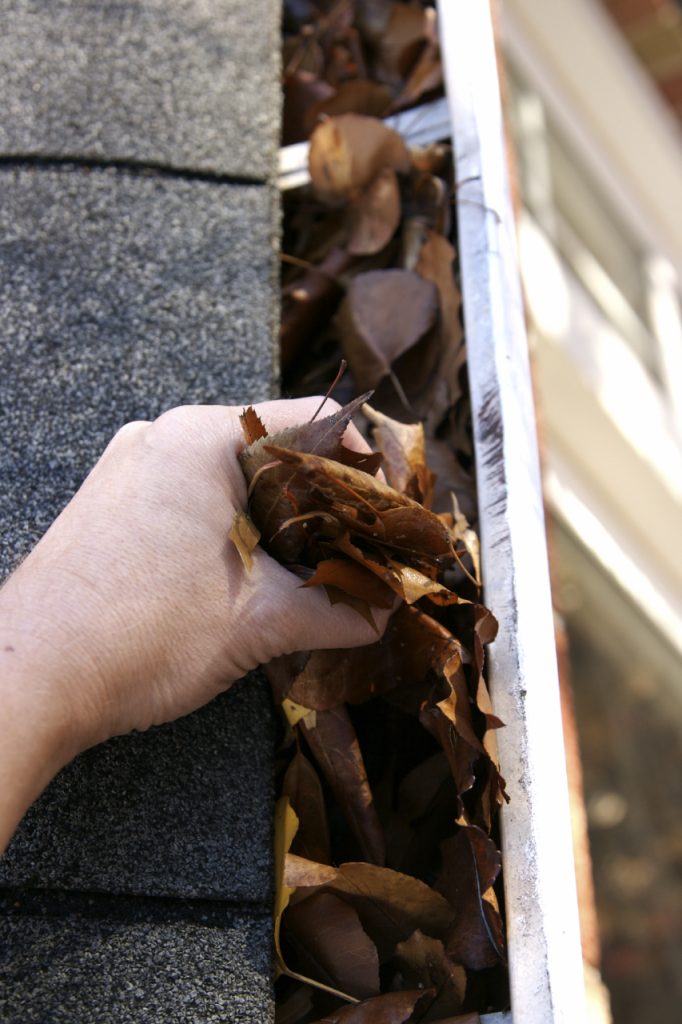
What’s in there usually isn’t just leaves. It’s leaves that broke down into dirt, plus the grit that washes off asphalt shingles year after year. That mix packs into the bottom of the gutter, holds water, and eventually grows things.
Where to look, and this is the part people get wrong:
– You cannot see into a gutter from the ground. A gutter can look perfectly fine from your driveway and be packed solid. You need to get up where you can see in, or have somebody do it.
– Check the bottom of the downspout, not just the gutter. A wad of leaves wedged in the elbow at the bottom will back up the entire run, and from the ground that looks exactly like a clogged gutter. It’s a much smaller fix.
– Check the valleys first if you’re only checking one spot. Where two roof planes meet and drain into one line is where all the debris funnels through. That’s where the pile is.
Tells that it’s a clog: water coming over along a long stretch rather than at one point · a downspout that stays dry while the gutter runs over · standing water or sludge visible when you can see in · anything growing in it · water coming over in a LIGHT rain, not just a hard one.
🔑 That last one matters. A clog overflows in rain that shouldn’t trouble a gutter at all. The capacity problems further down this list only show up when it’s really coming down. If a normal afternoon shower puts water over your gutter, it’s clogged.
We price gutter cleaning separately, and one-story and two-story are different line items, because they’re genuinely different jobs.
—
When it’s clean and still overflowing
Now we’re into the five that aren’t debris. This is where the money gets wasted, because a cleaning doesn’t fix any of them and neither do covers.
FIRST, THE FREE THING TO DO
Go stand outside in the next hard rain and watch where the water comes over. Not whether — where.
One spot every time, or the whole run? Over the front edge, or down behind the gutter? Does it get worse the longer it rains, or stop after the first minute? That one observation narrows five causes down to one or two and it costs you nothing but getting wet.
—
2. A GUTTER IS A HOLDING TANK, NOT A PIPE
This is the thing that makes the rest make sense, and I’ve never seen another gutter company explain it.
Water comes off a roof faster than a downspout can swallow it. That’s true on every house in every hard rain. So the gutter’s actual job in a downpour is to hold what’s waiting its turn while the downspout works through it.
Which means two completely separate levers, and they fail independently:
– How much the gutter holds.
– How fast the downspouts empty it.
Undersize either one and water goes over the front edge — clean gutter, correct pitch, nothing wrong with the installation.
—
3. NOT ENOUGH DOWNSPOUTS
One downspout per 40 feet of gutter run. That’s the number we work to.
Count them. A 160-foot roofline with two downspouts is half the drainage that house needs, and nobody thinks to count — not the homeowner, and sometimes not whoever quoted it. If you’ve got a quote in your hand right now, count the downspouts on it against the length of your roofline before you sign anything.
More on what to look for on an estimate in [the gutter cost post — LINK].
—
4. THE DOWNSPOUTS ARE TOO SMALL
Pure geometry, and you can check it with a tape measure:
2×3 downspout — 6 square inches
3×4 downspout — 12 square inches
Twice the opening. Rule of thumb that two independent sources agreed on: roughly one square inch of downspout per 100 square feet of roof draining to it. So a 2×3 covers about 600 square feet, a 3×4 about 1,200.
ONE CORRECTION, because this is wrong all over the internet: you’ll read that 5-inch gutters get 2×3 downspouts and 6-inch gutters get 3×4, as though it’s a rule. It isn’t. You can put 3×4 downspouts on a 5-inch gutter or a 6-inch gutter. Downspout size is a separate decision from gutter size, and treating them as a package is how houses end up with a big gutter that still can’t drain.
—
5. THE GUTTER IS TOO SMALL FOR THE ROOF
A lot of our work is replacing 5-inch gutters with 6-inch on houses that needed 6-inch in the first place.
Spectra, the manufacturer whose coil we run, puts the difference at 40% more water flow. You’ll see “50% more” on nearly every gutter company’s website, unsourced. I went looking for where that number comes from and couldn’t find it — the whole hunt is in the cost post. Use 40, and if somebody quotes you the 50, ask them where they got it.
We don’t install 5-inch gutters anymore. 6-inch is the only size we hang, because the price difference between the two is pennies, and when the cheaper option saves you almost nothing and carries less water there’s no honest reason to keep selling it.
—
6. IT’S PITCHED WRONG, OR THE GUTTER IS PULLING OFF THE HOUSE
Here’s the one that costs you real money if you ignore it.
Look at the front face of your gutter. Nail heads showing every few feet mean you’ve got spikes and ferrules — a long nail driven through the gutter into the fascia board. Spectra’s own installation standards say it plainly: spikes “over time always pull out of the wood taking the gutter with it.”
When that happens the gutter tips forward and drops at the fastener, and water starts going behind the gutter instead of into it — onto the fascia, the soffit and the framing. That’s not a nuisance any more. That’s rot.
How to tell it from the others: water comes over at the same spot every time regardless of how hard it’s raining · standing water in the gutter after the rain stops · you can see daylight or a gap between the gutter and the fascia · the fascia and soffit are stained, soft or peeling under it.
We hang on hidden hangers at 24-inch spacing. SMACNA’s standard is 36 inches; Spectra recommends 24; we run 24. Minimum pitch is a quarter inch per 10 feet.
If it’s already into the wood, the fascia and soffit repair is its own line item — generally $1,500 to $2,500 depending on how far it’s gone.
—
7. IT’S A VALLEY
If the overflow is at one spot, every time, and you follow the roof up from that spot to where two planes meet and run together — that’s your answer.
A valley dumps more water than any gutter or any cover can handle on its own. Two whole planes of roof draining into one line, and it arrives at speed.
So we cut the valley, install a screen, and usually a valley guard, specifically to stop that water running over the gutter at that spot. And it’s the same place the debris piles up, for the same reason — everything off both planes funnels through there. Which is why it’s both a capacity problem AND the first place to look for a clog.
—
The one that isn’t a problem at all: It only does it for the first minute
If you have gutter covers and you’ve stood at the window during a downpour watching water launch off the front of them, nothing is wrong.
Covers work on surface tension. Think about filling a glass of water. Fill it slowly and let it overflow and the water runs down the side of the glass. Dump a five-gallon bucket into it and water splashes everywhere.
Same thing on a cover. The surface has to get wet first. Once it’s wet, the water grabs the cover and runs into the gutter. When a hard rain first hits, before the surface wets out, some of it jumps. Give it a minute and watch again.
How to tell this one from a real problem: it happens all along the run, only in the opening minute of a hard rain, and it stops. A real capacity problem gets WORSE the longer it rains, not better.
—
What covers will not fix
Worth saying, because people buy them hoping they will:
– Covers don’t fix bad pitch. A gutter pulled off the fascia still dumps behind itself with a cover on it.
– Covers don’t fix undersized or too-few downspouts. You can keep every leaf out of a gutter that still can’t drain fast enough.
– Covers aren’t a never-clean-again promise. We go into that at length in [the leaf protection post — LINK].
And covers go on clean, pitched gutters. If somebody’s selling you covers over a gutter packed with dirt, without dealing with what’s underneath first, that’s the wrong order of operations.
—
Things that look like overflow and aren’t
– Black vertical streaks down the face of the gutter. That’s “tiger striping” — dirt, not water going over. Stubborn, and it doesn’t mean anything is failing.
– Dripping at a corner. That’s a leak at the miter, not an overflow. We hand-cut and lace our miters rather than using pre-made miter boxes, because a box adds two seams at every corner — and if a gutter’s going to leak, a corner is where it does it.
– Rust spots in the bottom of a steel gutter. That’s end of life, not a drainage problem.
—
So what does it cost to fix?
Depends entirely on which one it is, and that’s the honest answer.
Most of these calls end with a cleaning, which is the cheapest thing on the list and priced separately by story. Re-pitching gutters that are otherwise in good shape is next. New 6-inch gutter runs about $8.25 a foot installed; taking the old system off is about $2.86 a foot. On a small job there’s a setup charge, which is mobilization, not a minimum — all of that is broken down in [the gutter cost post — LINK].
I’m deliberately not printing a per-foot re-pitch number here. When I went through our own records that line had gone out at four different rates in the same month on similar jobs, and I’d rather tell you I’m still sorting that out than publish a number I’d have to walk back. Ask for it on your quote and ask what it covers.
—
What I’d do if it were my house
1. Look in the gutter, or have somebody look. You can’t see in from the ground. Anything growing in it ends the investigation.
2. Check the bottom of the downspout while you’re at it. Cheapest possible fix.
3. If it’s clean, watch it in the rain once. Front edge or behind it. One spot or the whole run. First minute or the whole storm.
4. Count your downspouts against your roofline. One per 40 feet.
5. Measure one downspout. 2×3 or 3×4.
6. Look at the face of the gutter for nail heads. Spikes mean it’ll eventually pull off the fascia, if it hasn’t already.
7. Look up from the spot where it overflows. A valley above it explains it.
8. Then call somebody — and if the first thing they recommend is covers without looking at any of the above, call somebody else.

Thomas Williams is part of the team behind All American Renovations, helping homeowners throughout Middle Georgia and Metro Atlanta make informed decisions about exterior renovations. With hands-on experience in siding, roofing, and home improvement projects, Thomas focuses on helping homeowners understand their options, compare materials, and know what to expect before starting a renovation.