By Thomas Williams, All American Renovations Metro Atlanta and Middle Georgia · September 2026
A basic deck — composite boards, affordable railing — runs about $15,000 to $25,000 around here. A deck built to look like the one in the magazine runs $50,000 to $100,000.
That’s a six-fold spread, and if you’ve got two quotes in your hand that are miles apart, your first instinct is that somebody is trying it on. Usually nobody is. They’re pricing two different decks and nobody has explained the difference to you.
Here’s the difference, in the order it moves the number.
1. Are you replacing the deck, or replacing the boards?
This is the biggest single swing and it happens before anybody picks a color.
Resurfacing means your posts, footings and framing are sound, and we take off the old boards and rails and put new ones down. Rebuilding means the structure goes too — new posts, new footings, new framing, new everything.
The gap between those two is thousands of dollars, and it isn’t only lumber. A rebuild brings demolition, a dumpster, footings, and usually drawings and a permit. On a full teardown we do, that bundle alone runs about $4,500 before a single deck board goes down.
So the first question isn’t what you want. It’s what you’ve already got. If your structure is sound, keeping it is the cheapest real money you’ll save on this project — and we’ll tell you when it is.
2. How big is it — and more importantly, what shape?
Everybody expects square footage to drive the price. It does. But the shape matters more than people think, and here’s why.
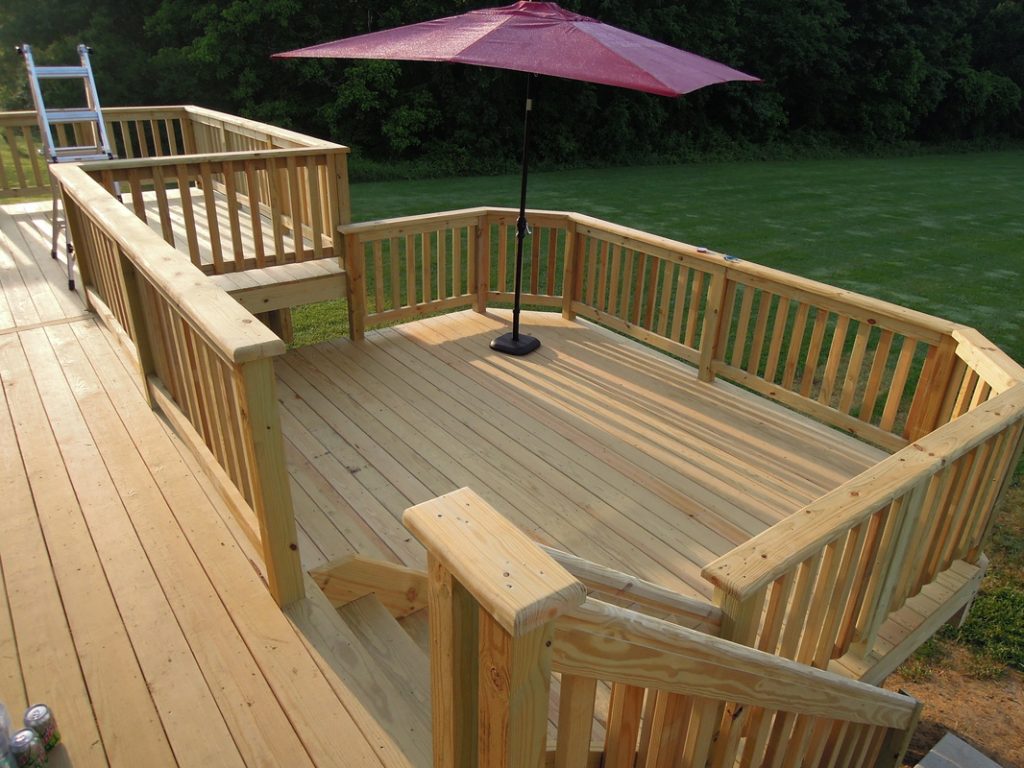
Railing is sold by the foot of perimeter. Decking is sold by the square foot of floor. A long skinny deck, or a small one, is almost all edge — so you’re buying a lot of railing to cover very little floor. A big square deck spreads the same railing over far more space.
On one small porch we rebuilt, the railing cost nearly twice what the decking cost. Across our recent deck jobs, railing came out ahead of the floor on more than half of them.
Nobody shopping a deck is thinking about the rail. It is routinely the most expensive thing on the job.
That also means the fixed costs land harder on a small deck. The dumpster, the demo and the permit cost about the same whether your deck is 150 square feet or 650. On a small deck that’s real money per square foot. On a big one it disappears.
3. How high off the ground is it?
A deck two feet off the grass and a deck twelve feet up are not the same job, even at identical square footage.
Taller means more stringers, landings on the stair runs, and a lot more railing — because now the stairs need railing on both sides too, and so does the landing. Footings get deeper. Posts get longer.
Go stand in your back door and look down. That drop is a bigger cost driver than the color you’ve been agonizing over.
4. The railing system — and the one upgrade that surprises everybody
Horizontal cable railing is the thing everyone wants until they see the number.
Here’s what nobody explains. It isn’t the cable that costs money. It’s the hardware at the ends of every run.
With the classic composite rail systems, a cable run needs a termination set — fittings, hanger bolts, lock nuts — at every single stop. Every straight run. Every corner. Every transition onto the stairs.
On one large cable-railing deck we built, the deck needed sixteen of those hardware kits — one for nearly every section of railing on the job. That hardware was the single biggest line on the entire material order. Bigger than the cable. Bigger than all the deck boards.
So cable railing doesn’t have one price. It has a price per corner.
The two ways to buy cable railing, and why the quotes come out so different
There are two routes, and most homeowners are only ever shown one.
The classic composite rail systems run cable as an infill inside a composite rail. It’s the look most people picture. Every stop needs its own termination set — fittings, hanger bolts, lock nuts — so the hardware count is driven by how many corners and stair transitions your deck has, not by how long the railing is.
TimberTech Impression Rail Express® is a powder-coated aluminum system that offers cable as an infill too. It’s panelized — the sections arrive pre-assembled rather than being built baluster by baluster — and it doesn’t need that termination hardware at those same transitions.
Here’s the honest version of the comparison:
On a simple rectangle with four corners and one stair run, the two aren’t far apart. There aren’t many termination points, so the hardware doesn’t pile up.
On a deck with angles, a couple of stair runs and a landing, the gap gets large fast — because every one of those points is another kit on the classic system and isn’t on the aluminum one.
This is not a cheap version of the same thing. Aluminum and composite rail look different and feel different, and you may simply prefer one. Both sit in the manufacturer’s top tier for labor warranty coverage, so you’re not trading protection for price either way.
What matters is that you’re shown both, with the termination count in front of you, before you pick. Most people never are.
⚠️ One thing to know before you put cable anywhere near water. Cable rail infill carries no warranty at all in what the manufacturer calls a water application — the splash zone, or contact with pool or hot tub water. That’s the exact spot most people want it, because that’s where they want the view. I’ve written separately about what these warranties do and don’t cover.
5. The decking material — but probably not the way you think
People agonize over the collection and the color. Within one product line, that’s a rounding error — on a job we priced three ways, the difference between collections came to about a thousand dollars on a twenty-five-thousand-dollar deck.
The decision that actually moves the number is the material line itself.
We install four-sided capped boards and nothing below that. Above that floor there are two real choices:
Capped composite has a polymer cap on all four sides — including inside the grooves, which is where the fasteners go and where water sits — over a core that still contains reclaimed wood fiber. Thirty-year product warranty, thirty-year fade and stain.
Advanced PVC has no wood in it anywhere. Longer fade-and-stain coverage, and a product warranty that runs for the life of the product rather than counting down.
Advanced PVC costs about two and a half times what composite costs for the boards — not the twenty percent people expect. On a mid-sized deck that’s several thousand dollars in the surface alone.
(Whether that’s worth it comes down to the warranty terms, and there’s more to those than the headline years. That’s its own article and I’ve written it separately.)
We’ll also install pressure-treated boards if you absolutely will not consider composite. We recommend against it, we put the reason in writing on your proposal, and it carries no warranty against warping, cracking or splitting. Expect to be replacing them in a few years. Almost nobody takes us up on it.
6. What you add underneath and overhead
These are the items that take a deck from one bracket to the next.
A drainage system underneath — aluminum panels that catch the water coming through the boards and turn the space below into dry, usable square footage. On one deck we built it added about fourteen dollars a square foot.
Lighting. Post lights, riser lights, under-rail lighting. Worth knowing: lighting means an electrician, and that labor is part of the number.
Screening in a covered porch — if the roof is already there — ran about $11,500 on a recent job: framing, screen, spline, two doors, aluminum trim.
Building a roof over a deck that doesn’t have one is the big one. That’s $20,000 to $40,000 depending on finishes, and it’s most of what separates a $30,000 project from an $80,000 one.
⭐ Walk your deck before you call anybody
Three things, five minutes, no ladder.
1. Count the sides that need railing. Then look at how much floor you’ve got. If it’s a lot of edge and not much floor, expect railing to be the biggest line on your quote — and don’t be surprised when it is.
2. Count your corners and stair transitions. Every one of them is a termination point. If you want cable railing, that count is your price — and it’s the number that decides whether the classic composite system or the aluminum one comes out cheaper on your deck. Write it down and make whoever quotes you show you both.
3. Look at how far down it is from your back door to the ground, and whether your posts and footings are still solid. Sound structure is the single biggest saving available to you, and any honest contractor will tell you when you have it.
Write those three answers down before anybody walks your yard. Every company that quotes you is going to work them out anyway. You just get to know them first.
The uncomfortable part
A small deck is the most expensive deck you will ever buy, per square foot. The setup costs the same, the railing-to-floor ratio is worse, and there’s less floor to spread any of it across. We can’t fix that and neither can anybody else. If you’ve got a small deck and a tight budget, resurfacing an existing sound structure is usually the honest answer, and it’s the cheaper job for us too.
We’re also not the cheapest way to buy a deck. We install to a floor we don’t move off — four-sided capped boards, manufacturer fasteners, flashing and joist protection you’ll never see. A contractor working below that floor will beat our number. They should be able to. They’re building something different.
And these are 2026 numbers for Metro Atlanta and Middle Georgia. Decking material has climbed noticeably in the last two years — one line we install went up seventeen percent in thirteen months. A range from an older article is not your range.
What I’d tell you if you called me
- Find out what your structure is worth before you shop. Sound posts and footings can take thousands off the job.
- Ask for the railing priced separately. If a contractor won’t break it out, that tells you something.
- If you want cable railing, ask to see it priced both ways — the classic composite system and the aluminum one — with the termination count shown. On a deck with angles and stairs those two numbers are not close.
- Don’t agonize over the collection. Agonize over composite versus PVC, and over the railing. That’s where your money actually goes.
- If a roof is on your wish list, price it first, because it will reshape everything else on the list.
Ready to Talk About Your Deck Project?
We build decks across Metro Atlanta and Middle Georgia. Happy to walk yours and give you a straight number — and if resurfacing what you’ve got is the better answer, we’ll tell you that instead.

Thomas Williams is part of the team behind All American Renovations, helping homeowners throughout Middle Georgia and Metro Atlanta make informed decisions about exterior renovations. With hands-on experience in siding, roofing, and home improvement projects, Thomas focuses on helping homeowners understand their options, compare materials, and know what to expect before starting a renovation.