By Thomas Williams, All American Renovations · EPA Lead-Safe Certified Firm
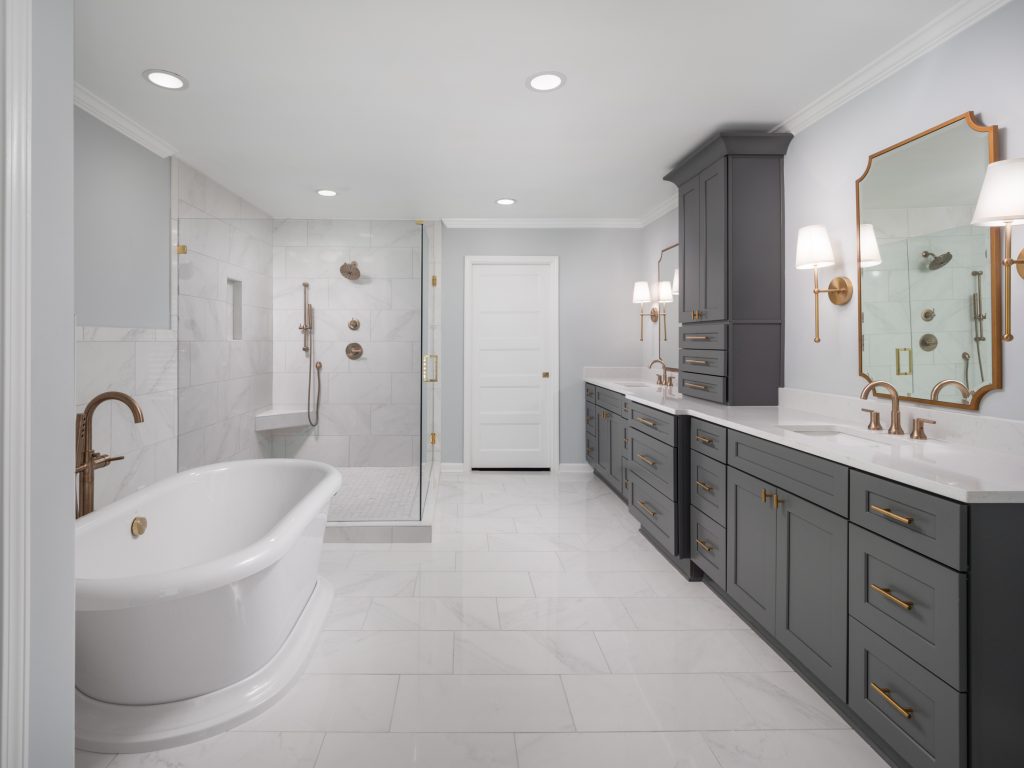
A master bathroom with a tub, a shower and a double vanity generally runs $25,000 to $60,000 here. A secondary bathroom runs $15,000 to $30,000. You can spend $100,000 on a master if you want to. If you asked me what to budget for a master, I’d say $40,000 to $50,000 — and I’ll explain below why that’s higher than the middle of the range.
Most people calling about a bathroom aren’t afraid of the number. They’re afraid of not being able to tell whether the number is fair — because they’ve never bought one of these before, they’ll buy one more in their lifetime at most, and every contractor who walks through the door knows more about it than they do.
What Does A Bathroom Renovation Actually Cost Around Here?
Two numbers, because there are really two different jobs people call a bathroom.
A MASTER BATHROOM — tub and a shower, double vanity — generally $25,000 to $60,000.
A SECONDARY BATHROOM — $15,000 to $30,000.
And you can get genuinely extravagant and spend $100,000 on a master. That’s not a scare number. That’s a real thing people do, and if that’s the bathroom you want, it exists.
Notice that the split isn’t square footage. People ask me about size and size matters some, but what actually separates those two numbers is how many fixtures are in the room and how nice the things going into it are. A master has a tub AND a shower and two sinks. That’s three wet installations instead of two and twice the cabinet run, before anybody picks a tile.
Ranges as of October 2026, Middle Georgia and Metro Atlanta.
What Would I Tell You To Budget?
For a master: $40,000 to $50,000.
That is deliberately higher than the middle of the range I just gave you, and here’s the honest reason. The $25,000 end of that range is real, but it’s a master bath where almost every selection lands at the bottom of its option. Very few people stay there once they’ve sat down and seen the choices.
Not because anybody upsells them. Because a person who has waited eleven years to redo their bathroom looks at the cheaper tile, looks at the nicer tile, does the arithmetic on the difference across one room, and picks the nicer tile. That’s a completely rational decision and I’d probably make it too.
Some people do stay at the bottom of the range, and they get a good bathroom. Those are customers working to a tight number who are willing to make what we call SMART, BUDGET-CONSCIOUS DECISIONS — taking the ready-to-assemble cabinet, staying on a 12×24 tile, keeping the framed glass, leaving the fixtures where they are. None of that is settling. It’s choosing where the money goes. If that’s you, say so on the first call and we’ll work that way on purpose.
But most people want what they want, and they land toward the higher end.
So if you budget $30,000 for a master bath, the most likely outcome isn’t that you get a $30,000 bathroom. It’s that you spend the whole project saying no to things you want, and you finish it slightly disappointed in a room you’re going to look at every morning for a decade.
Budget $40,000 to $50,000, and if it comes in under, that’s a good day.
What Moves The Number Most – And How Much Of It Is Your Choice?
Here’s the reassuring part, and it’s true: most of what moves a bathroom number is you deciding things. Only a small piece of it is the house.
The Things You Choose
Tile, and format matters more than people expect. Porcelain or marble is the obvious one. But the bigger lever is the size of the tile, because most people now want as few grout lines as possible. Most of the market has settled on a 12×24 — demand is high, supply is high, and the price point is good. Go up to a 24×24, or to a full slab in the shower or on the floor, and it climbs a long way: larger format, thinner supply, and a great deal more labor to set it right.
Cabinets — we carry three lines, and it’s a real ladder:
– A ready-to-assemble base grade. Not builder grade — it’s a decent cabinet — but it comes in set sizes with a limited range of colors and door profiles. Most cost-effective by a distance.
–Fabuwood — semi-custom.
–Plain & Fancy — full custom. Any color, effectively any species, any stain, any size. Want a single five-foot cabinet instead of three boxes joined together? That’s this line, and it costs accordingly.
Then everything else you pick: plumbing fixtures, light fixtures, mirrors, cabinet hardware, and the finish package across the room. Frameless shower glass versus framed is a bigger jump than most people guess.
Adding electrical, and replacing shower valves — which comes up constantly, because when somebody takes out an old shower they usually want more fixtures in the new one, or different ones, and that means new valves.
And a zero-entry shower, where there’s no curb to step over. The floor has to slope to the drain for that to work, which is more work than a curbed shower. Worth knowing: we can do that with a system like Schluter or Guru without getting into the floor framing at all. Schluter has a tray and board arrangement for it; with Guru it’s their boards, worked to make the slope. Either way nobody is cutting into the structure of your floor to get you a curbless shower. If you’re on a concrete slab it’s a different story — the concrete has to come up to make the changes.
The Things The House Decides For You
Short list, and you didn’t pick any of it.
The age of the house, and what’s behind the walls. Cast iron drain lines push a number up. Copper water piping is its own situation. You don’t find out which you’ve got until somebody opens a wall.
Slab or framed floor — see the zero-entry note above. That’s your house, not your taste.
Lead paint, in an older home. Mitigation adds to the cost. We’re an EPA Lead-Safe Certified firm, so we handle that ourselves.
ASBESTOS, AND THIS IS THE ONE WHERE I TELL YOU NO. If a house is old enough that asbestos is a possibility, we don’t touch it — an asbestos mitigation company comes in and handles it, and then we work.
And I’d be careful with anybody who gives you a year on asbestos. I went looking for the clean cutoff date and there isn’t one — the EPA’s 1989 ban was largely overturned in court, residential uses were phased out gradually through the late seventies, and the remaining uses weren’t banned until 2024. So “your house is from 1975, you’re fine” isn’t a thing anybody can honestly say. It gets tested, not guessed at.
Will I Have To Pay For A Design Before I Get A Price?
A lot of the time, no — and this is where most people assume the worst.
Three questions, and you can answer all three yourself right now:
1. Is any fixture changing location? Is the toilet moving across the room?
2. Are the cabinet sizes changing?
3. Is a tub becoming a shower, or a shower becoming a tub?
All three no, and there’s no design retainer. We make the selections first — with me or with Stephanie at our design center — then Chris Sineath comes out and measures, then you get a price off the design and layout. You sign off on your selections before there’s a number.
New countertops on your existing cabinets. A new tile floor. Taking out a jetted garden tub and putting in a freestanding tub, or a built-in tub with a tile shower. All of that is this path, and it can be a master bath, not just a secondary one.
Any one of those three a yes, and the job needs a real design — and a design costs money, because it’s a designer and a draftsman doing hours. Swapping a valve isn’t that. Moving a toilet across the room is.
Note what’s not on that list: the price. A $45,000 master bath where everything stays where it is doesn’t need a design retainer. A $28,000 bathroom where the toilet moves does. It’s never been about how big the number is — it’s about whether anything moves.
★ What Can You Look At To Know The Shower Was Build Right?
This is the part of a bathroom that decides whether you’re doing it again in five years, and almost nobody tells homeowners about it.
Behind the tile in your shower there has to be a waterproofing system. Not a coat of something. A system.
Schluter is the name most people have heard — it’s become the Kleenex of this category, where the brand stands in for the thing. We use Schluter and we use Guru, and our installers have the same confidence in either one. What matters isn’t which of them is on your job. It’s that one of them is.
If it’s missing, or done wrong, you will not know. Not for a while. Then it leaks, and the fix isn’t a repair — the shower comes out completely and gets built again. Call it five years.
Here’s the thing nobody realizes: you can see it. There’s a window.
On a shower with a curb, a mud bed has to go in and dry before anybody can set tile. Waterproofing and tile physically cannot happen on the same day. Which means there are days in the middle of your own bathroom project when the waterproofing is in and the tile isn’t on yet — and you can walk in and look at it.
Two things to do with that:
BEFORE YOU HIRE ANYBODY — look at the quote and find the waterproofing. Is a system named? Not “waterproofing” as a line item. A named system. If it isn’t there, ask what it is and expect a specific answer — and one that includes ANSI A118.10, the standard a bonded waterproof membrane has to meet. Run that on our quotes too.
DURING THE JOB — ask when that window is, and go stand in it. Here’s what to look at. These aren’t my opinions; they’re the manufacturers’ own requirements, and Schluter publishes theirs where anybody can read them.
Does the membrane go high enough? Schluter’s handbook sets the minimum at the height of the showerhead. In a fully enclosed shower it goes on every surface — ceiling, door jambs, door header.
Is every seam banded? Seams and fastener holes get covered with waterproofing band, and Schluter specifies a 2-inch overlap. You can see whether the seams are covered or whether somebody trusted the thinset.
Are the corners preformed pieces? Inside and outside corners get purpose-made waterproofing corners. A corner that’s just band folded into itself is not the same thing, and you can see the difference.
Is there a proper seal where the pipes and the valve come through? Those penetrations get purpose-made seals, not a smear of something.
Does the floor actually slope? On a mortar bed Schluter calls for 1/4 inch of fall for every 12 inches. Put a level on it. Or it’s a factory pre-sloped tray, in which case the slope came built in.
And ask two questions you can’t see the answer to:
“DID YOU WATER TEST IT BEFORE TILING?” Schluter strongly recommends a water test before any tile goes on. On a curbless shower it needs a temporary dam at the threshold to hold the water. A contractor who tested it will be pleased you asked.
“WHEN DID THE MEMBRANE GO IN?” Schluter’s own instruction is to wait a minimum of 24 hours after the membrane is finished before tiling — partly so the thinset sets, partly to confirm the seams are actually waterproof. So this isn’t me being fussy: if your tile went on the same day the waterproofing did, the manufacturer’s own handbook was not followed.
One fair note. The figures above are Schluter’s published numbers. We also use Guru, whose system is built the same way — bonded membrane, band, preformed corners, pipe and valve seals, pre-sloped trays. Both are certified to ANSI A118.10, which is the American standard for bonded waterproof membranes under tile. If you want one question that works on any contractor and any brand, it’s that one: does the membrane meet ANSI A118.10?
One honest limit on all this. Tile that isn’t level — a corner standing proud where two pieces meet — and grout lines that wander are things you can see and feel, and they tell you something about the care that went into the room. But they are an indicator, not proof. Bad tile work doesn’t automatically mean the waterproofing is wrong. I’m not going to tell you it does.
What We Won’t Do Cheaper, And What It Costs Us
Waterproofing a shower is a floor we will not go below. Not for anybody, not at any price.
And I’ll tell you exactly what the cheaper version buys you: a shower that looks identical to ours on the day it’s finished, for less money, and you have no way of telling the difference. That’s the whole problem. The savings are visible immediately and the cost is invisible for years.
Yes, this loses us work. Somebody collecting three bathroom quotes who doesn’t know to ask about waterproofing sees our number next to a cheaper one and takes the cheaper one, and from where they’re standing that’s a sensible decision. I’d rather lose that job than build that shower.
Two more honest ones while I’m at it.
We are not the right call for a small single-trade bathroom job — swap a vanity, retile one floor. There are good contractors who do that work well and we’d be more process than you need. Ask us and we’ll say so.
And if you want the lowest number, it isn’t going to be ours. That’s a longer conversation and I’ve written it out separately.
What I’d Tell You If You Called Me
– Budget $40,000 to $50,000 for a master, $20,000 to $25,000 for a secondary. Then be pleasantly surprised rather than squeezed.
– Run the three questions before you call anybody. Is a fixture moving, are the cabinet sizes changing, is a tub becoming a shower. You’ll know what kind of project you’ve got.
– Find the waterproofing system on every quote you get. If it isn’t named, that’s your first question.
– Decide your tile format early, because it moves the number more than the material does and it’s the easiest thing to change your mind about late.
– If the house is older, expect a surprise behind a wall — cast iron, copper, lead paint. Nobody can price what nobody can see yet.
– Narrow your selections to two options you’d be happy with before you meet anybody about design. It’s the single cheapest thing you can do for yourself.
Want to Know What Your Bathroom Renovation Could Cost?
Want a straight range for your bathroom before anybody comes out? Call and ask — we’ll tell you on the phone. We’re in Hampton, with a design center in Forsyth, and we work across Metro Atlanta and Middle Georgia.

Thomas Williams is part of the team behind All American Renovations, helping homeowners throughout Middle Georgia and Metro Atlanta make informed decisions about exterior renovations. With hands-on experience in siding, roofing, and home improvement projects, Thomas focuses on helping homeowners understand their options, compare materials, and know what to expect before starting a renovation.