Thomas Williams, All American Renovations
Hampton and Forsyth, Georgia · October 2026
Six-inch seamless aluminum, hung on hidden hangers at 24 inches, with hand-cut laced corners, 3×4 downspouts, and one downspout for every 40 feet of gutter.
That’s the whole answer. The rest of this page is why each of those is on the list, and how you check whether you’re being given it — because every gutter quote in Georgia looks identical on paper and almost none of them tell you any of this.
One thing before I go further, because it’s the biggest conflict of interest in anything I’ve written. We don’t just install leaf protection — we manufacture one. Everclean is ours. We own the machine that makes it. So when leaf protection comes up below, I’m not a reviewer, I’m a manufacturer, and I’ve kept that section deliberately short and pointed you at the post where I lay the whole thing out. [Are gutter covers worth it? — link to post 21]
I know the real question underneath this one, too. It isn’t what’s the best gutter. It’s “all four of these quotes say seamless aluminum gutters and they’re thousands apart, and I can’t tell what I’d actually be getting for the extra money.”
Here’s what the difference is made of.
Size: Six Inches, And Nothing Else
We don’t install five-inch gutters anymore. Six is the only size we hang. A good share of our work is taking five-inch off a house that needed six in the first place.
The reason isn’t performance, it’s arithmetic. The price difference between five and six is pennies. When the cheaper option saves you almost nothing and carries less water, there’s no honest reason left to sell it.
And here’s the figure to be careful with. Every gutter company’s website says six-inch holds 50% more water than five-inch. I went looking for where that number comes from and couldn’t find it — not one of those pages sources it, one of them contradicted its own math, and two calculators both citing the same standards body gave me answers an order of magnitude apart.
The number I’ll stand behind is 40%, and it’s from the manufacturer whose coil we actually run. If somebody quotes you the fifty, ask them where they got it.
The part that makes gutter sizing finally make sense: a gutter is a holding tank, not a pipe. In a hard rain, water comes off your roof faster than any downspout can swallow it. The gutter’s whole job in that moment is to hold what’s waiting its turn. Bigger gutter, more holding. That’s it.
Which means there are two independent levers — how much the gutter holds, and how fast the downspouts empty it. Undersize either one and water goes over the front edge. More on the second one below.
How It’s Hung: Hidden Hangers, 24″ Apart
The industry standard for hanger spacing is 36 inches. The manufacturer of the coil we run recommends 24. We run 24.
That’s not heroism, it’s a third more hangers on a material that costs pennies a foot. But it’s the difference between a gutter that still has its line in fifteen years and one that bellies in the middle and holds standing water.
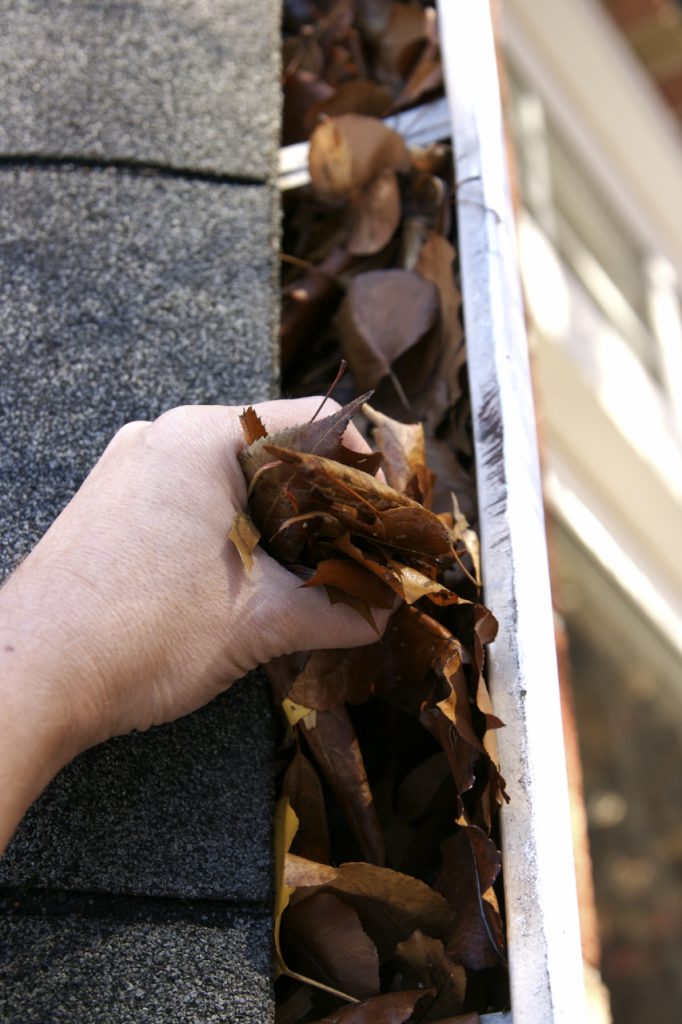
Spikes are the other half of this. If your current gutters are held on by nails driven through the front face into the fascia, those will eventually pull out of the wood — and when they do, water and debris go behind the gutter and sit directly against your house. [How to spot it from the ground, and what new gutters cost — link to post 20]
The Corners – And This Is The Thing To Go Look At
This is where gutters leak. Not in the middle of a run. At the corners.
There are two ways to turn a corner. You can buy a pre-made miter box — a separate manufactured piece that drops into the corner — or you can cut and lace the corner by hand out of the same continuous gutter.
The miter box adds two seams per corner. Every seam is a future leak. We hand-cut and lace every corner, and we use close to half a tube of gutter sealant on each one.
“If you’re going to have a leak in a gutter, it’s going to be there.”
So here’s your check, and you can do it from the ground on most houses:
Go look at an inside or outside corner of your gutter. Is the corner a separate piece with a visible seam on each side of it — or is it one continuous piece of metal folded around the corner?
Separate piece with two seams = a boxed miter. One continuous fold = hand-cut and laced.
Then ask every company bidding your job which one they do. It costs you nothing, it takes ten seconds, and it is the single best predictor of whether your gutters will leak — because it’s the only place on the whole system where somebody had to choose between fast and right.
The Downspouts – Both The Size & The Number
Two separate decisions, and people get told they’re one decision.
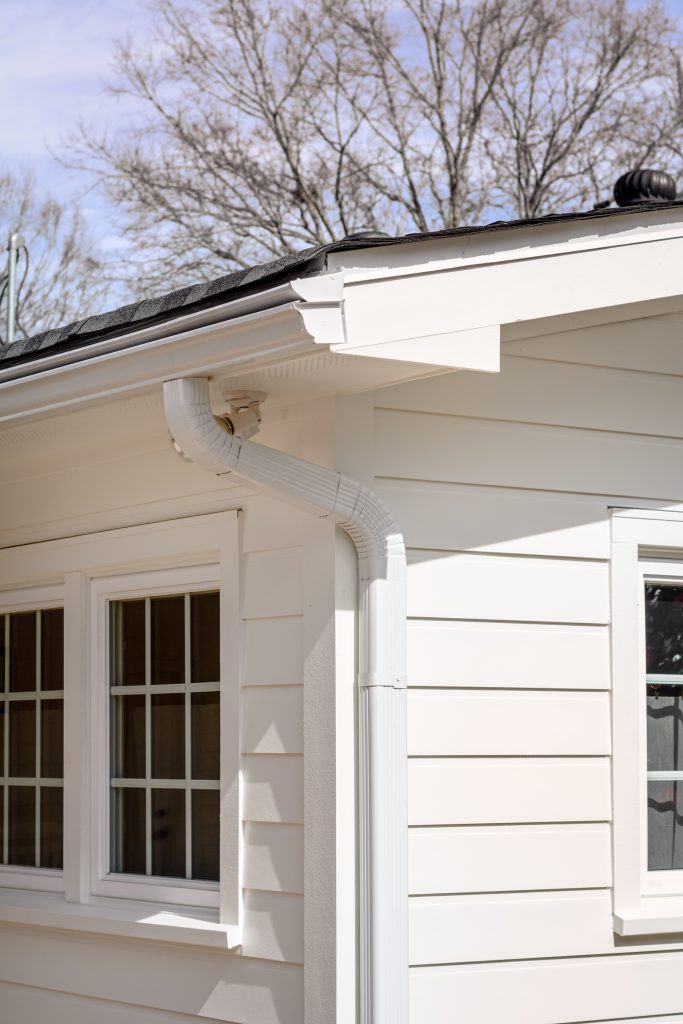
First, a correction to something you’ll read everywhere. The internet will tell you five-inch gutters get 2×3 downspouts and six-inch gutters get 3×4. That’s wrong. You can put 3×4 downspouts on either size. Downspout size is an independent choice, and treating it as automatic is how a six-inch gutter ends up draining through a 2×3.
The math is just geometry and you can check it with a tape measure:
— 2×3 downspout: 6 square inches of cross-section. Roughly covers 600 sq ft of roof.
— 3×4 downspout: 12 square inches of cross-section. Roughly covers 1,200 sq ft of roof.
That’s double, for a few dollars a stick. The rule of thumb behind those coverage figures — about one square inch of downspout per 100 square feet of roof — is the one figure every source I checked agreed on.
Second, the count. The spec is one downspout per 40 feet of gutter.
And this is the one nobody thinks to do: count them. Take the quote in your hand and count the downspouts on it, then look at how much roofline you’ve got. 160 feet of gutter draining through two downspouts is not enough gutter system, no matter how good the gutter is. Nobody counts. Go count.
The Boring Specs, Which Are Also The Cheap Ones
— Seamless, run on site. A seamless run can go up to 100 feet with no joint in it. Sectional gutter from a store comes in 10-foot pieces, which means a seam every ten feet. [Seamless vs sections — link to post 35]
— Minimum 1/4 inch of pitch per 10 feet. Too little and it holds water; too much and you can see it from the street.
— .027 aluminum coil. That’s the standard residential thickness. 3105-H24 alloy, about 97% recycled.
— Aluminum hangers, not steel. Steel and aluminum sit at opposite ends of the galvanic scale and corrode where they touch. This one is invisible and it matters.
— Half-round is a real option if that’s the look you want — and I’ll tell you up front that our own leaf protection doesn’t work with it. For half-round you’re looking at a different cover or a stainless micro-mesh screen. I’d rather say that than sell you a gutter profile that fits what I make.
WHAT WE WON’T DO, AND IT’S THE ONE THAT COSTS US JOBS
We will not tie new gutter into your existing gutter or existing downspouts.
Not as a judgment call. As a policy.
“Our new gutter would be attached to someone else’s work. We can’t warranty their work, because we don’t know how they installed it, what they used or didn’t use.”
What we’ll do instead: install a section that doesn’t connect to the old gutter — but it’ll be six-inch, with its own new downspouts. On a five-inch house that means the new section is visibly a different size. That’s a real consequence and you should know about it before you hire us, because somebody else will happily splice into what’s there and it’ll look better on day one.
And the reason this matters past gutters, on any partial job of any kind: ask what the new work is being attached to, and who warranties the joint. A tie-in fails at the seam where two installers’ work meets, and when it does, nobody can tell you whose side failed. That question works on a roof, on siding, on a deck, and on us.
Two Things That Will Quietly Void A Warranty
Don’t paint pre-finished aluminum gutters. Paint will stick to them. It also voids the manufacturer’s 20-year paint finish warranty the moment you do it. A factory finish is a finish, not a primer — same story as painted vinyl siding, and it catches people the same way.
And be careful with leaf protection that mounts under your shingles. A lot of gutter guards are installed by sliding them under the first or second course — which can create roof warranty problems, break shingles going in, and turn any future roof repair into an uninstall. [The whole argument, including where my own product sits — link to post 21]
One more thing nobody warns you about: tiger striping. Those black vertical streaks that show up on gutter faces are road film and oxidation, they’re specific to the front face, and they’re very hard to remove once they’re set. Not a defect. Just a thing nobody mentions.
Where This Runs Out
A perfect gutter system doesn’t fix a water problem. If you’ve got water in a crawlspace or against a foundation, the gutter is one of three or four things involved, and sometimes it’s the least important. Grading, downspout extensions, and where the water actually goes once it leaves the building matter more than the gauge of the aluminum — and we don’t do grading or drainage. If that’s your real problem, a new gutter is a nice thing you’ll have bought that didn’t solve it.
And gutters are not where your money is. On a full exterior job this is the cheapest line on the page. I’m not going to pretend six-inch versus five-inch is a life decision. It’s a pennies decision that nobody bothers to make correctly, which is a different thing.
The last honest part: almost everything above is a spec, and specs are easy to say and hard to verify after the fact. The corner is the exception. That’s why it’s the one I’d send you to go look at.
What I’d Tell You If You Called Me
— Go look at a corner. Boxed miter or hand-laced. Best question on this page.
— Count the downspouts on your quote against your roofline. One per 40 feet.
— Ask what size the downspouts are — 2×3 or 3×4 — and don’t accept that it’s decided by the gutter size, because it isn’t.
— Ask the hanger spacing. The answer should be 24 inches, and most people will have to go find out.
— Six inch, not five. The savings are pennies and the capacity isn’t.
— Don’t let anybody splice new gutter into old, including us. Ask who warranties the joint.
— If the real problem is water in your crawlspace, call somebody who does drainage first (We can send you a referral as well) and gutters second.
— And don’t paint them. What new gutters cost
If You Want To Talk About Your Gutters
We’ve been hanging gutters in Henry County since 2001 — it’s the trade this company started in. Happy to walk your house and give you a straight number, and if the job belongs with somebody else, I’ll tell you that too.
All American Renovations · Hampton and Forsyth, Georgia · (770) 629-0589

Thomas Williams is part of the team behind All American Renovations, helping homeowners throughout Middle Georgia and Metro Atlanta make informed decisions about exterior renovations. With hands-on experience in siding, roofing, and home improvement projects, Thomas focuses on helping homeowners understand their options, compare materials, and know what to expect before starting a renovation.