By Thomas Williams, All American Renovations · EPA Lead-Safe Certified Firm
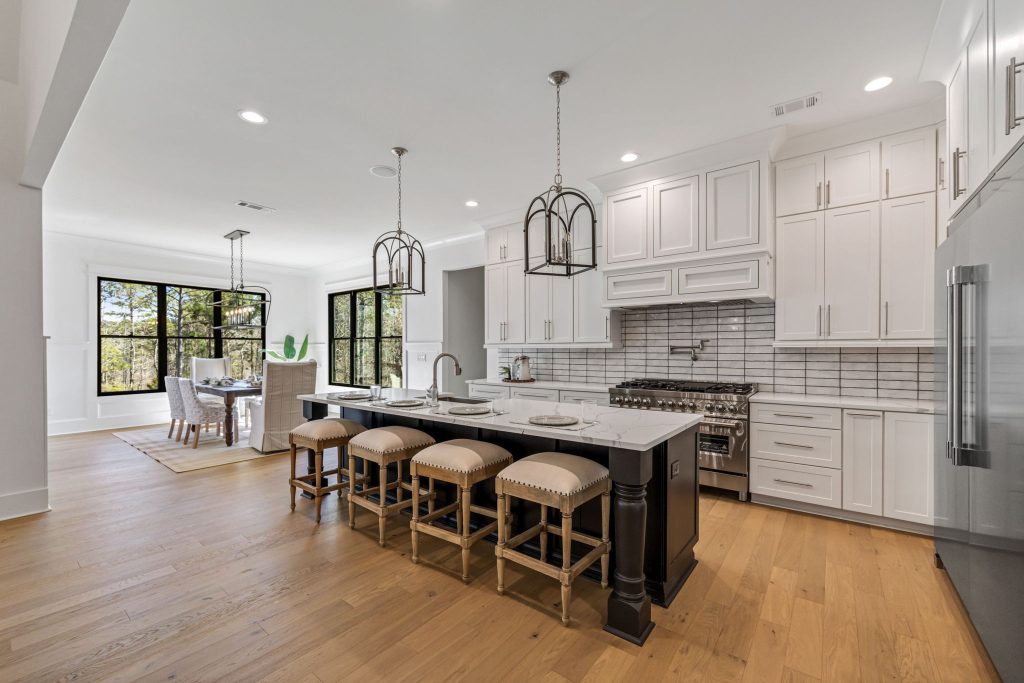
You can renovate a kitchen here for $25,000 to $30,000 — cabinets, countertops, backsplash. Start adding lighting, glass in the cabinet doors and better appliances and you’re easily at $60,000 to $80,000. Put high-end appliances in it — Wolf, JennAir, that tier — and $100,000 is a real number, not a scare story. All three of those are kitchens. The difference between them is almost entirely what you choose.
Three things do most of that moving: cabinets, countertops and backsplash, and appliances. Not one of them. And all three are decisions you make rather than conditions you inherit.
The reason kitchen pricing feels impossible isn’t the range, though. It’s that you can’t compare the quotes you’re holding. One might include a refrigerator and one might not. One says “quartz countertops” and means a level 1; the other says “quartz countertops” and means a level 12. Nothing on either page tells you that in a way you’d notice.
One scoping note before the numbers, because it’s the honest thing to do. This post is about renovating the kitchen you have, in the space it’s in. Changing the shape of the room is a different kind of project with a different kind of number, and it gets its own post rather than a paragraph in this one.
───────────────────────────────────────
What Does a Kitchen Renovation Actually Cost Around Here?
Three tiers, and I’d rather describe them by what’s in them than hand you one range.
$25,000 TO $30,000 — THE STRAIGHTFORWARD KITCHEN
Cabinets, countertops, backsplash. New boxes, new tops, new tile behind the range and the sink. That’s a real kitchen renovation and it transforms a room.
What it generally doesn’t include: new lighting beyond what’s there, glass in the cabinet doors, and appliances.
$60,000 TO $80,000 — THE ONE MOST PEOPLE ACTUALLY END UP DESCRIBING
You get here by adding things that sound small and aren’t.
Lighting — under-cabinet, in-cabinet, pendants over an island, recessed changed out. Glass in the cabinet doors, which costs more than solid doors and usually means the interiors get finished properly too, because now you can see them. And upgraded appliances.
That’s the jump most people don’t see coming, because each of those three reads as a detail on a selections sheet and together they can double the project.
$100,000 — HIGH-END APPLIANCES
If you’re putting Wolf or JennAir-tier appliances in, you can spend $100,000 on a kitchen without doing anything exotic to the room itself.
But appliances aren’t the only route here. A level 12 quartz with the same slab run up the wall as the backsplash, on a full-custom cabinet line, gets you well up this range on its own. The $100,000 kitchen is usually two or three of those decisions stacked, not one.
Ranges as of October 2026, Middle Georgia and Metro Atlanta.
What Would I Tell You to Budget?
If you want nice things and you don’t want to break the bank — $35,000 to $50,000.
Notice where that sits. It’s below the $60,000 to $80,000 tier, not above it. That’s the genuinely reassuring thing about kitchen pricing and almost nobody says it: you do not need to spend sixty thousand dollars to get a kitchen you’re delighted with.
What the step up from $25–30,000 buys you is room to pick the good version of the three things that matter — a better cabinet line, a countertop that isn’t at the bottom of the range, and a backsplash you actually chose — without taking any of them to the top.
This is the opposite advice from our bathroom post, and the difference is real. On a master bathroom I tell people to budget ABOVE the middle of the range, because the bottom end means saying no to things all the way through. On a kitchen the useful number is lower than the one people have in their heads, because the headline figures are driven by appliance packages and top-level stone rather than by the kitchen itself.
Budget $35,000 to $50,000. Spend it on the three levers below. Add appliances to that figure or not, depending on whether yours are staying.
★ Why are Two Kitchen Quotes $40,000 Apart?
Two checks, and between them they explain most of it. Both take five minutes on paperwork you already have.
CHECK ONE — THE APPLIANCE LINE
Go through each quote looking for the appliance line. Then answer three things:
– Is there one at all? Some quotes include appliances. Some assume you’re buying them. Plenty don’t say either way.
– If there is one, what’s in it? Range, refrigerator, dishwasher, microwave, hood, wine fridge? Or just “appliances”?
– Does it name brands and models, or a dollar allowance? An allowance is not a price — it’s a placeholder, and you’ll find out what it was really worth on the day you go shopping.
An appliance package can be the difference between a $30,000 project and a $70,000 one, with identical cabinets and identical countertops. So two quotes that look $40,000 apart may be pricing the same kitchen, and one of them simply left the appliances out.
That’s not usually anybody hiding anything. It’s genuinely ambiguous in this trade, and most contractors don’t make it explicit because they don’t realize it’s confusing.
CHECK TWO — WHAT LEVEL IS THE COUNTERTOP?
This is the one almost nobody knows to ask, and it’s the better question of the two.
Quartz is sold in levels. A supplier’s range might run from a level 1 up to a level 12, and the difference between the bottom and the top of that range is enormous.
Which means “quartz countertops” on a quote tells you nothing at all. Both ends of that range are quartz. Both are accurate descriptions. They are not remotely the same price.
And here’s the part almost nobody will explain, because there are two separate things going on.
THE LEVELS COME FROM THE MANUFACTURER. Each one grades its own product line, which means a level 6 from one manufacturer is not a level 6 from another. The number tells you how far up THAT MANUFACTURER’S range a slab sits, and nothing more.
THE PRICE ATTACHED TO IT COMES FROM SOMEWHERE ELSE ENTIRELY — the installer, the supplier, the vendor. So the same slab, from the same manufacturer, can be a different number on two different quotes.
Which means ask four things:
– What level, and from which manufacturer? The level only means something inside that manufacturer’s own range.
– What’s the slab actually called? The product name is the only thing that travels.
– Is it engineered or natural stone? Quartz is engineered. Granite, marble and quartzite are quarried. Different materials, different fabrication, different money.
– How many square feet, and is there an overhang on the island? Area and edge work are the other half of a countertop number.
And here’s why the slab name is the question that pays. Get two quotes to name the same slab and you’ve turned an apples-to-oranges comparison into an apples-to-apples one. Whatever price difference is left after that is the contractor’s labour, fabrication and markup — which is the comparison you were trying to make in the first place. COMPARE LEVELS AND YOU LEARN NOTHING. COMPARE NAMES AND YOU LEARN EVERYTHING.
And one more on the backsplash: running the countertop material up the wall as the backsplash is a very strong trend right now, and it’s a significant cost — it’s more of the most expensive material in the room, plus more fabrication. A quote with “backsplash” on it could mean a subway tile or it could mean twenty more square feet of stone.
Run both checks on our quotes too. If our countertop line says “quartz” and a number, ask me what level, and I should be able to tell you without looking it up.
What Moves the Number Most?
Nearly all of it is your choice. And there are three big levers rather than one.
THE THREE THAT MOVE IT MOST
Cabinets. Three lines, and the step from one to the next is real money. We’ve written that comparison out in full — what’s actually different between ready-to-assemble, semi-custom and full custom, and the surprising answer that the box is much the same across all three. Read that one before you shop.
Countertops and backsplash, together. Level 1 quartz or level 12. Engineered or natural stone. And whether the backsplash is tile or the same slab running up the wall — see check two above. This is the lever people underestimate most, because a countertop reads as one line item and it has a twelve-step price range inside it.
Appliances. Enormous range, and the one most often left ambiguous on a quote — which is a separate problem from how much it costs.
THEN EVERYTHING ELSE
Lighting. Under-cabinet and in-cabinet lighting means electrical work inside a cabinet run. It looks like a small line and it isn’t.
Glass cabinet doors. More than solid doors, and the knock-on is that cabinet interiors get a finish treatment they’d otherwise not need.
Flooring, if it’s in scope, and fixtures — faucet, pot filler, hardware.
Will I Have to Pay for a Design Before I Get a Price?
Often not, and the test takes ten seconds. Three questions:
1. Is any fixture changing location? Is the sink moving? The range?
2. Are the cabinet sizes changing?
3. Is the layout of the room changing at all?
All three no, and there’s no design retainer. Selections come first — with me or with Stephanie at the design center — then Chris Sineath measures, then you get a price off the design and the layout, and you sign off on your selections before there’s a number on anything.
New cabinets in the same sizes, new tops, new backsplash, new appliances in the same openings. That’s the simple path, and it’s a large share of real kitchen work.
Any one of them a yes, and it’s a drawn job — a designer and a draftsman, and a retainer that’s a percentage of the project. The price doesn’t decide this. The what decides it. A $70,000 kitchen where everything stays where it is needs no design fee. A $35,000 kitchen where the sink moves does.
Where This Doesn’t Suit You
We are not the cheapest kitchen in the market and I’m not going to pretend otherwise. If the lowest number is what you’re after, somebody will beat ours.
And we’re more process than a one-item job needs. Replacing a countertop on its own, or a single run of cabinets? There are good contractors who do exactly that work and we’d be overkill. Ask and we’ll say so.
The honest thing I’d want a reader to know: the $25,000 kitchen is real and it’s good work. The reason most people don’t end up there isn’t that we push them. It’s that they sit down, see the glass doors and the under-cabinet lighting and the appliance they’ve wanted for nine years, and decide. That’s a reasonable way to spend money, and it’s why the range goes where it goes.
What I’d Tell You If You Called Me
– Run both checks on every quote you have. Find the appliance line, and ask what level the countertop is.
– Decide whether appliances are in your budget or outside it before you shop, and tell every contractor which. You’ll get comparable numbers.
– A dollar allowance is not a price. Ask what it actually buys, at today’s prices, by name.
– “Quartz” is not a spec. Ask the level, the manufacturer, and what the slab is called. Levels are the manufacturer’s own grading and don’t cross between brands; pricing is set by whoever’s quoting. Only the slab name travels.
– Decide early whether the backsplash is tile or slab. Running the countertop material up the wall looks wonderful and it is not a small line.
– Read the cabinet comparison before your design appointment. The box is similar across all three lines; what you’re buying is options. Knowing that saves money.
– If you’re keeping the layout, say so on the first call — it changes whether there’s a design fee at all.
– Lighting is not a small line. Decide early whether you want in-cabinet and under-cabinet, because adding it late is worse.
Thinking about a Kitchen Renovation?
Want a straight range for your kitchen before anybody comes out? Call and ask — we’ll tell you on the phone. We’re in Hampton, with a design center in Forsyth, and we work across Metro Atlanta and Middle Georgia.

Thomas Williams is part of the team behind All American Renovations, helping homeowners throughout Middle Georgia and Metro Atlanta make informed decisions about exterior renovations. With hands-on experience in siding, roofing, and home improvement projects, Thomas focuses on helping homeowners understand their options, compare materials, and know what to expect before starting a renovation.