Thomas Williams, All American Renovations Metro Atlanta and Middle Georgia · September 2026
“Licensed and insured” means two different things, and in Georgia only one of them usually means what you think. For roofing, siding, gutters and decks there is no state license to hold, so “licensed” is mostly a business license. “Insured” is the half that protects you, and you can check it yourself in about ten minutes.
That matters because the phrase is doing a lot of work on a lot of trucks, and most homeowners have no way to tell what’s behind it. You’re about to let somebody onto your roof or into your walls, and the one line meant to reassure you is the one nobody explains.
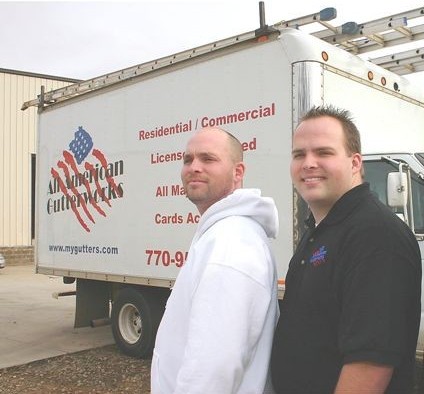
We said it too.
Where does “licensed and insured” even come from?
It was painted on the side of our gutter truck twenty-five years ago. So I’m not pointing at anybody.
Back then I thought it meant what most contractors still think it means: we have a business license, we carry workers comp, we carry liability. And to an extent, it does.
The problem isn’t that contractors are lying. I don’t think most of them are trying to mislead anybody. We all inherited the phrase. The problem is what it sounds like to you — that the state looked at this company and approved it to do your specific job. In Georgia, for most exterior work, that’s almost never what’s being claimed.
What does “licensed” mean for a roofer or a siding contractor in Georgia?
Usually a business license, because that’s the only license that exists for the work.
Georgia’s State Licensing Board for Residential and General Contractors issues three contractor licenses: Residential Basic, Residential-Light Commercial, and General Contractor. The state’s other specialty boards cover electrical, plumbing, conditioned air, low voltage and utility work.
There is no roofing license. There is no siding license. No gutter license, no deck license. Not a hard one to get. There isn’t one. So nobody holds one, including us.
What a roofer or siding contractor can have:
- Business licenses in the cities and counties that require them. We hold several. That’s permission to operate a business in that jurisdiction. It says nothing about whether anybody can hang siding.
- A voluntary program. The Georgia Roofing Contractors Association runs a voluntary licensing program because the state won’t. We’re a GARCA member. We have not completed the voluntary license, and I’m not going to let a sentence on this page imply we have.
- A manufacturer program, which is a standard somebody signed up for because they wanted it, not because the law asked.
I think Georgia should license roofing and siding the way it licenses mechanical contractors, and I’ve said so in Best Siding Contractors in Metro Atlanta. A license is a barrier, and the people it keeps out are exactly the ones you’d want kept out. Until that changes, “licensed” on a roofing or siding truck is telling you less than it sounds like.
When does a contractor’s license actually matter?
When the project needs a permit that only a licensed contractor can pull. Additions, structural changes, a lot of interior work. That’s where the state license is real, it has a number, and you can look it up.
So the useful questions aren’t “are you licensed.” They’re these:
- Which company signs my contract?
- Does that company hold a Georgia contractor license, and what’s the number?
- If not, which company does, and who is the qualifying agent?
- What insurance does the company signing my contract carry?
Then take the number to the Georgia Secretary of State’s own lookup at verify.sos.ga.gov and read what comes back: the name, the license type, whether it’s active.
I’m giving you that third question on purpose, because it applies to us. How our two companies fit together is at the bottom of this page, written out in full.
What does “insured” mean, and which insurance actually protects you?
This is the half that matters on an exterior job. There are three policies worth knowing about:
- Workers’ compensation pays for somebody who gets hurt working on your house.
- General liability pays for damage the contractor does to your property, or to somebody else.
- Commercial auto covers the trucks and trailers in your driveway.
We carry significant coverage on all three. But “we carry insurance” is the claim. The certificate is the proof.
Here’s the part most homeowners don’t know. Georgia only requires an employer to carry workers’ comp once it regularly employs three or more people, according to the State Board of Workers’ Compensation. A two-man crew can be perfectly legal and have no workers’ comp at all. Legal isn’t the question you care about. The question is who pays if somebody falls off your roof.
What about the subcontractors?
Ask this every time, because it’s where the gap usually is.
Most of the people on a job in this trade are subcontracted crews. Ours are too — siding, roofing, windows and paint all work under written independent contractor agreements, with two of our gutter installers on our own payroll. Every subcontractor carries their own workers’ comp and general liability, and we carry our own over the top of theirs. Two layers, not one. It’s a condition of working with us.
So ask it in two parts, and in this order:
- Do the people physically on my house carry their own insurance?
- And do you carry yours as well?
If you only ask “are you insured,” you’ll get a yes from a company whose crews carry nothing. More on who’s actually at your house in
⭐ How do you check all of this yourself?
Ten minutes, a phone, and three websites run by the people who issue these things. No contractor has to be involved, including me.
- Look at the truck, the yard sign or the website. If it says “licensed,” ask: licensed by whom, for what, and what’s the number? A real state contractor license has a number you can look up at verify.sos.ga.gov. If the answer is a city business license, that’s fine. Just know what it is.
- Ask for the certificate of insurance before anybody starts. Then read three lines on it: the name of the insured (does it match the company on your contract?), the policy dates (is it current today, and will it still be current when the job ends?), and which policies are listed (is workers’ comp actually on there?).
- Look the company up on the State Board of Workers’ Compensation’s coverage verification. It’s free and public. If a company tells you it carries workers’ comp and the state has no record, call the Board — the number is on that page.
- If your house was built before 1978 and the job disturbs paint, the company should be an EPA Lead-Safe Certified Firm. EPA runs a firm search. We’re certified, and lead work is something we handle ourselves. If your firm isn’t in the search, EPA says to call the National Lead Information Center at 1-800-424-5323 and have them check.
That second check, the dates, is the one people skip. A certificate can be completely genuine and completely expired.
Why bother checking the dates on an honest company’s certificate?
Because I’ve sent the wrong one.
I once sent a customer an old copy of our certificate by mistake — the coverage was current, but the paper I emailed had dates that had already run out. I sent the current one, and they signed their contract.
Nobody was trying to hide anything. It was the wrong file in an email. But from where that homeowner sat, an expired certificate from an honest company looks exactly like an expired certificate from a dishonest one. The only way to tell them apart is to read the dates and ask.
So read the dates, on everybody’s. Including mine. If they’ve passed, ask for the current one. A company that’s covered can send it.
What I’d tell you if you called me
- Stop asking “are you licensed and insured.” Everybody says yes. Ask the four questions above instead.
- Get the certificate before work starts, not after. Read the name and the dates.
- Ask about the crews separately from the company. That’s where the gap usually is.
- Look the company up yourself on the state’s sites. It takes less time than reading this post.
- If somebody gets annoyed that you asked, you’ve learned something about how the next three weeks would go.
Want us on your list?
Ask us every question on this page, and ask for our certificates. If we’re not the right fit for your job, I’ll tell you who is.
No pressure, and no obligation to use us. If you just want to understand what you’re looking at before you talk to anybody, that’s a fine reason to call.
One thing about how a project like this gets signed, because you should know it before you hire anybody
Your contract is with AAX of GA Inc, doing business as All American Renovations. Where a project needs a general contractor’s license to permit, that permit is pulled through American Craftsman Homes — our sister company. Pete and I own both of them. Same two owners, same office, same people on your job.
We’re in the process of holding that license in All American Renovations’ own name, and when we do I’ll say so right here. Until then I’d rather tell you exactly how it works than let you assume.
Where to check every claim on this page
- Georgia Secretary of State — license verification
- Georgia State Board of Workers’ Compensation — employer coverage verification
- Georgia State Board of Workers’ Compensation — insurance FAQs
- EPA — Lead-Safe Certified firm search
- EPA — Renovation, Repair and Painting rule FAQs
Related Posts

Thomas Williams is part of the team behind All American Renovations, helping homeowners throughout Middle Georgia and Metro Atlanta make informed decisions about exterior renovations. With hands-on experience in siding, roofing, and home improvement projects, Thomas focuses on helping homeowners understand their options, compare materials, and know what to expect before starting a renovation.